Leading without a playbook starts with Vision

When leaders are mobilizing their teams to create new value for customers, speed isn’t the only thing that matters. Without a clear vision, decisions fragment and momentum stalls. Vision provides a shared picture of the future that orients choice, investment, and imagination—especially when old strategies no longer apply and the path forward must be created, not followed.
When creating new value, organizations first need a vision of where they’re headed. Too often, that stops short at a rousing statement of intention. While some organizations interchange the terms “purpose” or “mission” with “vision,” at SYPartners we find it helpful to define “vision” as the vivid picture of the future the organization wishes to create.
Think of it as a point that can be seen out on the horizon, attainable (sometimes through great effort) and time-sensitive. Visions at their best are:
- Enlivening and memorable for employees, as well as consumers and other external stakeholders. They should elicit the response, “That’s a world I want to live in!”
- Achievable in 3-5 years and believable as an essential goal that is within reach with the right commitment of time and energy. It is capable of shaping prioritization and investments.
- Authentic to the organization, and true to the moment. Given an organization’s expertise and aspirations, as well as the opportunities in the market and the world, a vision should guide the most important work the organization could be doing.
There are several reasons vision can be powerful tools for leaders. A shared vision can galvanize an organization, pointing them toward a single destination. It raises its level of ambition. It’s fueled by desire (a truly powerful motivator) for something newer, better, more promising. Perhaps most important, vision engages the imagination: Plotting its pursuit requires thinking through possibilities of new value you’ll discover along the way.
When they come to SYPartners to clarify their organization’s vision, leaders typically expect the work to culminate in a statement. That statement is important, though the work does not—cannot—end there (more on that below). It shouldn’t be treated as a writing exercise. Wise clients recognize this. Sometimes they’ve already engaged their agency of record to come up with a vision statement, as if it’s a tagline, and have realized in the process that the statement is a strategic, not a marketing, artifact, and requires thoughtful, planful activation.
How SYPartners helps shape vision
Crafting the vision statement typically starts at the top. Teams reasonably expect the organization’s leader or leadership team to set the vision and hold people accountable to achieving it. Occasionally, especially in founder-led organizations, a single leader already has a clear vision for the future they want the organization to create. More often than not, leaders see glimmers of that future, but aren’t able to describe it. Or a few leaders see one possible future, and their peer leaders see another.
So our work includes interviewing leaders to understand what they see and believe about the organization’s vision. We look at other raw material that already exists, too. We pull from speeches and other internal and external communication, strategic plans, and anything else that seems to tell a story about where the organization is headed. We assemble truths about the organization. We surface explicit and implicit vision-bits. Then we bring leaders together to interrogate different prototypes of possible visions we’ve described, all informed by this material (we call these ‘vision territories.’)
But rather than ask leaders to react to statements alone—which risks being just a shallow wordsmithing exercise–we paint a rich, vibrant, detailed picture of what each possible future might hold. We find it’s most powerful to immerse leaders in the implications of each vision territory, going so far as to bring those territories to life in the meeting space. We have them inhabit those possible futures imaginatively, and intellectually. Leaders work in small teams or duos to explore and describe each future state by asking and answering questions. As SYPartners CEO Jessica Orkin shared at a recent Fortune Most Powerful Women Summit, courageous questions don’t simply guide leaders—they reshape the field of what’s possible: If we pursue this vision, what would change about our value proposition? What new products might we make? What skills would we need? What might potential partnerships look like? Through the process, and thanks to the conditions we create for honest debate, leaders also explore the most basic and human implications: Are we up for this vision, as a team? What excites and terrifies us most when we think about pursuing it? Am I the right leader to guide us into this future?
As part of these leadership sessions, SYPartners drafts, refines, and finally codifies a vision statement. The process to get there yields so much more: By the time the statement is written, the leadership team is aligned behind the vision, having thoroughly played out on paper its implications for value-creation. They’ve described the bold and incremental moves required to get there. They’ve imagined how to equip teams, how to allocate investment, the role of AI, and what’s missing entirely in their asset pool.
Decades in, SYPartners has dozens of stories about how our process has given iconic organizations traction and momentum to start pursuing their vision quickly and purposefully. Here are just a few:
A vision that reignited growth
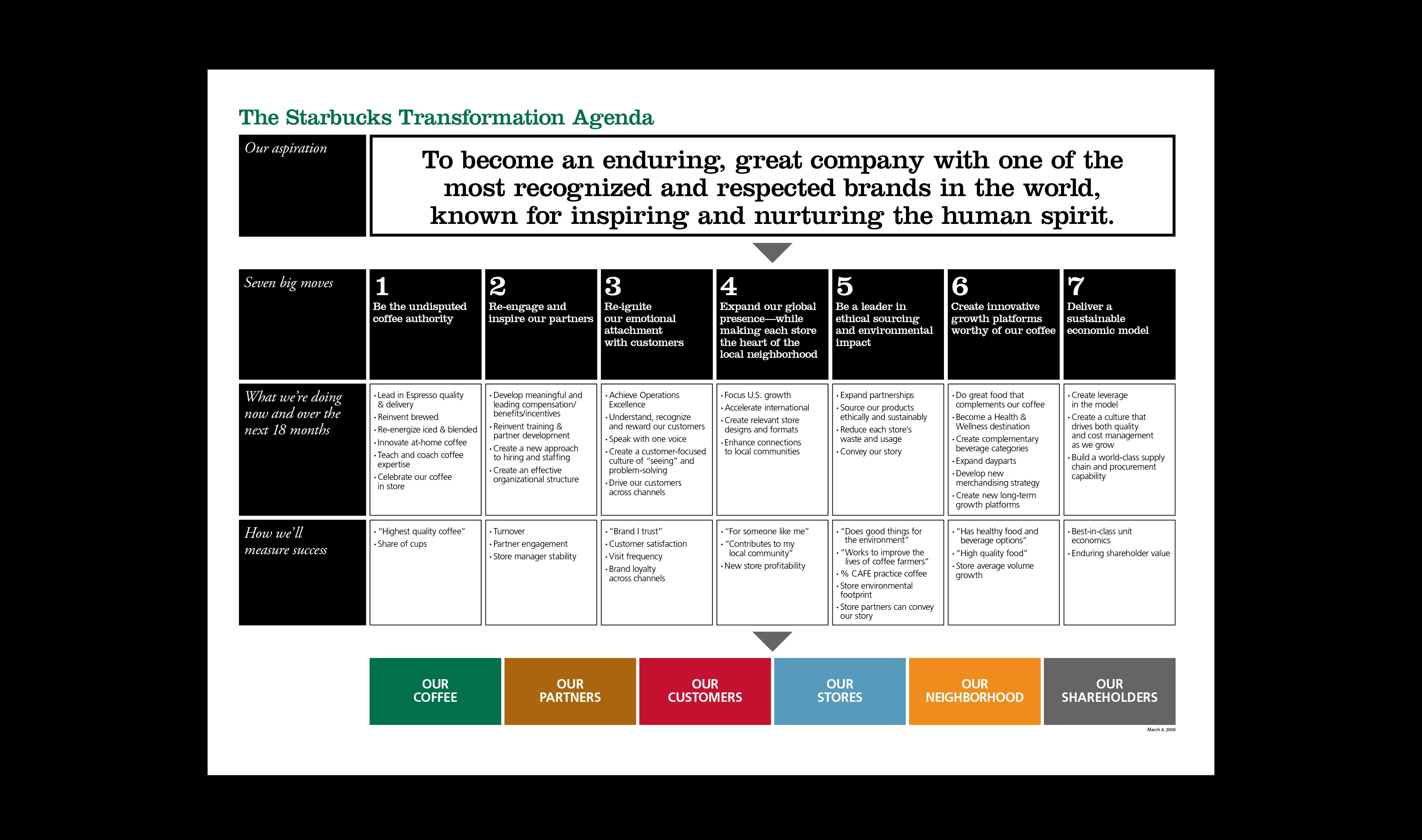
When Starbucks lost its way in 2008, SYPartners aligned the leadership team behind a new vision of what they wanted to become. The process required leaders to imagine and debate possible future retail and product experiences they might own in the market. The ultimate vision anchored a three-year strategic transformation plan, and sparked product and retail innovations that turned the business around.
Making a vision public
IBM inspired other companies and governments with the calling, “Let’s build a smarter planet”—putting forth a vision of what could be possible in an instrumented, interconnected, and intelligent world, and aligning its product and business strategy behind that vision. Among other IBM projects in this moment, SYPartners helped bring a conversation about “smarter planet” to the public quite literally, through this experiential exhibit in the heart of New York City.

More MOMENTUM
Leading without a playbook starts with Vision
In moments of uncertainty, speed without direction creates fragmentation. A clear vision aligns decisions, investments and imagination around a shared future. When old strategies no longer apply, vision becomes the anchor that helps leaders create the path forward rather than chase it.
Developing a strategy is a rehearsal of the future
Strategic planning now demands the discipline to imagine multiple futures before choosing a path. In volatile markets, fixed plans fall short; grounding strategy in Purpose and Vision keeps decisions, investments and priorities aligned, even as conditions change.
How to manage complex stakeholder interests? Think like a designer
As stakeholder capitalism reshapes how companies create value, leaders face a growing challenge: balancing complex, often competing demands. Managing stakeholder interests requires more than statements or promises. A design-led approach offers a practical way to make better decisions, align strategy, and build trust across stakeholders.