Collective leadership: The operating model for modern executive teams


The next evolution of leadership is not about who leads, but how leadership moves across a team. As organizations grow more complex, enterprise performance depends on leadership behaviors that shift beyond hierarchy. Collective leadership enables faster decision-making, stronger alignment and shared accountability across functions.
As organizations grow more complex, the model of leadership anchored in individual authority breaks down. No single executive can see enough, decide fast enough, or align the enterprise alone. When leadership remains concentrated, decisions slow, silos harden, and strategic momentum erodes.
I have the privilege of working with some of the most capable executives in their fields, leaders who hire other exceptional leaders and expect a great deal from one another. But when these teams convene, it can often feel like herding cats: strong points of view, competing priorities, and no clear mechanism for leadership to move as the enterprise needs it to.
Collective leadership offers a pragmatic, results-oriented approach that can unlock greater performance. This is a strategic operating model where leadership flows across the team in response to enterprise needs, supported by clear enterprise priorities, defined decision rights, and mutual accountability.
In practice, collective leadership is increasingly enabled by AI as it augments leaders’ ability to surface signals faster, model tradeoffs across functions, and make enterprise-level decisions without relying on hierarchy as the coordinating mechanism.
This model isn’t about consensus or flattening authority. It’s about unlocking collective potential by enabling leaders to work in concert, not in parallel—leading and following intentionally based on what the business needs most next.
A simple test: when a cross-functional decision goes poorly, does your team debate the call or quietly blame the function that made it?
Collective leadership comes into sharp focus in high-stakes moments:
- When strategy shifts in real time, leaders must both influence and defer to those closest to the signal.
- When decisions span functions, the most effective voice may be the most expert—not the most senior.
- When resources compete, leaders must weigh what’s best for their function and what’s essential for the enterprise.
- When alignment is fragile, it takes humility to fully commit to decisions you didn’t initiate—and discipline to signal that commitment consistently to the organization.
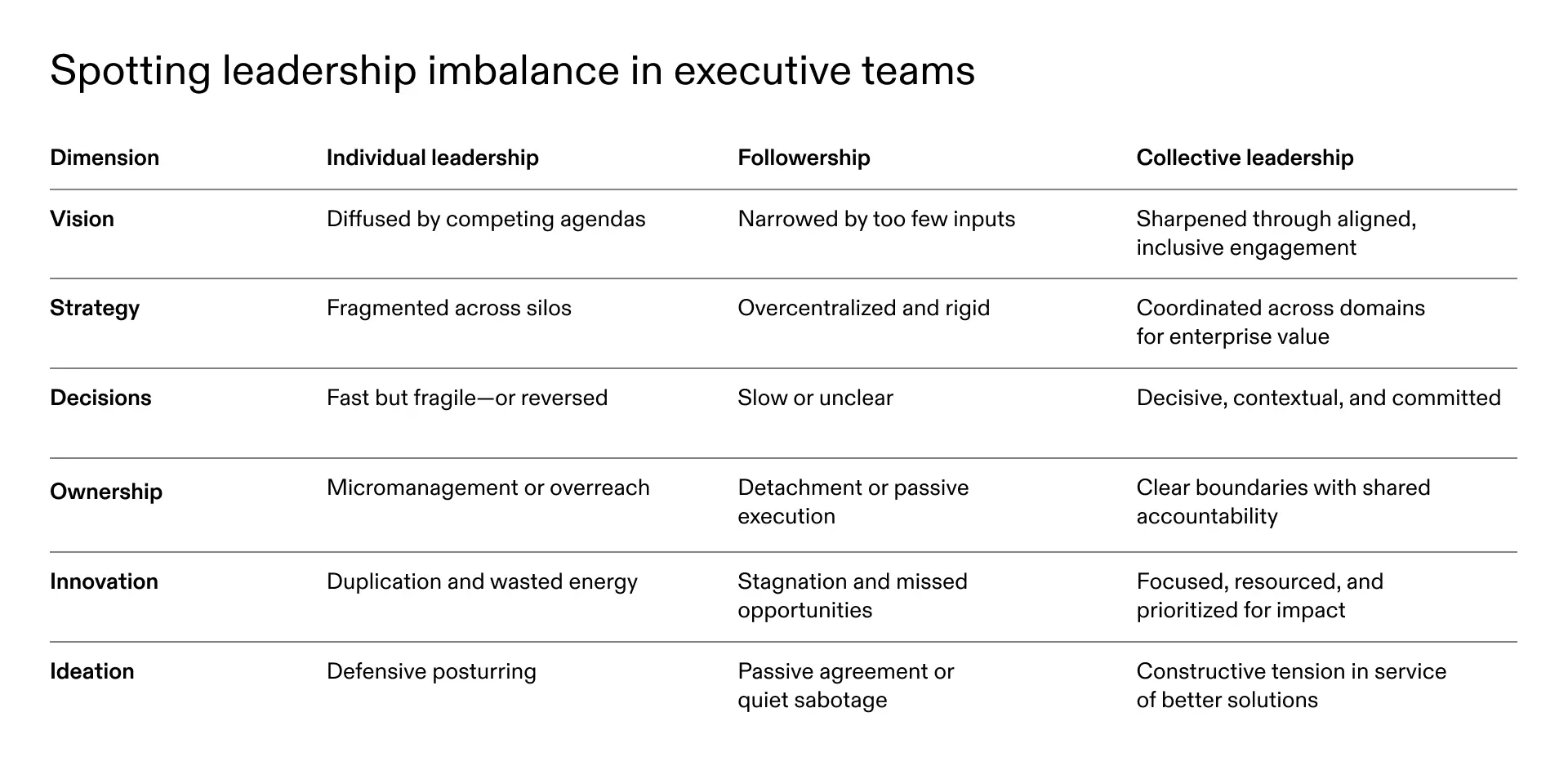
One concern often voiced: “If leadership is shared, who is ultimately accountable?” In collective leadership, accountability becomes both more personal and more explicit: you’re responsible for your domain’s outcomes, and you’re responsible for how your decisions affect enterprise momentum. Accountability is clarified through well-defined roles, decision protocols and the expectation of commitment once direction is set.
Three strategic shifts to unlock collective potential
Collective leadership isn’t a soft skill or a culture initiative. It’s a structural evolution in how executives lead together. These are the shifts that matter most:
1. From functional loyalty to enterprise stewardship
In siloed systems, leaders are incentivized to advocate for their domain. In collective leadership, executives orient toward what’s best for the enterprise—even when that means stepping back, deferring on decisions or reallocating resources to another function’s priority. This requires more than collaboration—it requires strategic interdependence.
2. From controlling outcomes to trusting aligned peers to deliver
The pace and complexity of modern business makes it impossible for any one leader to hold all the answers. Collective leadership is only possible when executives trust not just intentions, but judgment, capability and alignment across the table. across the table. Trust enables speed, and speed is a competitive advantage.
3. From challenge as critique to challenge as contribution
High-performing executive teams don’t avoid tension—they use it. But how leaders surface challenge determines whether it creates clarity or stalls momentum. Constructive challenge signals commitment to the work, not control of it. It helps teams course-correct without losing cohesion.
How to get started
You don’t need to overhaul your team overnight. Start small. Begin each leadership meeting by naming a shared enterprise priority. Let the person with the most relevant expertise lead the discussion, regardless of title. Celebrate when someone steps aside to let another lead.
As your team matures, look for signs of readiness to go further. Do people trust each other? Are team goals and incentives aligned? Is there clarity around strategic priorities? If not, that’s OK. Start building. Invest in coaching. Clarify who decides what. Create shared dashboards and routines that foster transparency and mutual accountability.
The results will show up in both behavior and business outcomes. You’ll notice decisions happening faster, especially across functions. Escalations will drop. Peer feedback will become more honest and constructive. And time spent in meetings will shift from defending turf to advancing shared goals.
Over time, collective leadership shows up in performance metrics: faster pivots, more aligned resource allocation and stronger follow-through on strategy.
- Speed of cross-functional decisions
- Number of escalations required for resolution
- Peer feedback indicating trust and shared ownership
- Time spent on enterprise vs. functional topics in meetings
- Quality and reuse of shared insights across functions
No single executive can deliver enterprise transformation alone. What differentiates high-performing leadership teams is not individual excellence, but the quality of their shared leadership: how they align, adapt, and accelerate together.
Collective leadership turns individual talent into enterprise momentum. What makes leadership effective isn’t where it sits—it’s how it moves.
More MOMENTUM
Navigating the shift from founder-led to founder-inspired
Leadership succession is an opportunity to strengthen—not replace—a founder's legacy. By distributing decision-making, codifying culture, and creating shared ownership, organizations can preserve what made them successful while building resilience for the future.
Zero-gravity leadership in the Age of AI
Leadership is being reshaped as AI rewrites how organizations operate. Informed by executive conversations and SYPartners’ research and client work, this perspective outlines the capabilities leaders need now, with a full report available to explore further.

Collective leadership: The operating model for modern executive teams
Collective leadership is reshaping how high-performing organizations operate. As complexity grows, leadership must move beyond hierarchy to enable faster decisions, stronger alignment, and shared accountability across teams. Organizations that distribute leadership behaviors across functions are better equipped to perform at enterprise scale.