Frame. Model. Coach. Enable.


Many leaders get stuck between doing the work themselves and delegating it away. But those aren’t the only options. This article introduces a practical leadership framework—frame, model, coach, enable—that helps leaders build capability, foster independence, and support teams without taking over.
Does this sound familiar?: Your team members so badly want to take work off your plate and prove they can handle things on their own. You want to give your team the independence they seek, but have this nagging feeling that they may not be quite up for the challenge. Despite this, you decide to give them a chance and stay out of it. When you finally see the work, it’s late in the game—too late. Adrenaline kicks in. You put on your superhero cape, take over, and save the day. But as a result, your team feels disempowered. And even worse, you haven’t done anything to build their skill to tackle the next challenge.
Many team leaders get caught up in this “do or delegate” dilemma: Should I do the work myself, in the interest of speed and effectiveness? Or should I delegate to my team, for their learning and development—and to give me some much-needed time back? On the flip side, your team members wonder: If we escalate something to our boss, do we risk seeming incompetent? Or, if we do all of the work ourselves, will we screw up and get blamed for it? Luckily, there’s a way out of this tension. And it starts with expanding your vocabulary beyond “doing” and “delegating.” At SYPartners, we’ve developed a framework inspired by Charles Plant’s adaptation of psychologist Kurt Lewin’s research on leadership styles. Our framework centers on four different modes for leaders to engage with their teams: Frame. Model. Coach. Enable.
Frame
While the idea that “the sky’s the limit” sounds exhilarating, for many people a blank canvas is just about the worst starting point. Without boundaries, guidelines, or constraints, teams can get easily overwhelmed and lose their way in the work. Think of framing as a strong starting point—to cut through the ambiguity, give shape to a challenge at hand, bring clarity to why the work is worth doing, and ensure everyone’s working within the same assumptions and guardrails. Framing is a form of doing, but with the intention to set others up for success, not to own and complete the work from start to finish. While framing may seem constricting, there’s plenty of freedom within a framework for teams to explore, create, and make the work their own.
Framing can take many forms:
- A briefing document that articulates the problem you are solving, why the work matters, the desired outcome, and possible approaches to get started.
- A sketch or rough prototype that moves the conversation from theoretical to tangible.
- A high-level work plan that structures and sequences the work and identifies the key milestones along the way.
- An outline of a presentation or agenda that maps out the main beats.
Model
Oftentimes teams have a general sense of what to do, but still may run into situations they have never encountered before. While we know instinctively that actions speak louder than words, many of us still resort to describing what needs to be done rather than showing it. Modeling means explicitly sharing not just what you do but how you do it, and the logic behind your choices. You can model behaviors, skills, approaches, and thought processes. For that reason, modeling cannot be done asynchronously—you need to invest the time side by side with your team. By modeling, you give others an opportunity to build their own capabilities.
The key to modeling effectively for your team is:
- Being explicit about the “why” behind what you are doing.
- Slowing down to let them digest information and ask questions.
- Speaking openly about what’s hard for you and what you don’t know, to lessen the pressure of perfection and provide context.
- Offering tips and tricks regularly, so that others might benefit from them, too.
- Providing space and permission for them to practice without worry of judgment.
- Encouraging individual approaches that build on what you’re modeling; this is not about creating mini-replicants of yourself.
Coach
When I think about the opportunities that have most accelerated my growth throughout my career, it’s been the times when I took on stretch assignments that I just barely convinced myself I was capable of achieving. In those situations, I carried full accountability and ownership, yet I had someone watching me, pulling me aside at the right moments, building my skill while building my confidence.
Coaching isn’t about hovering. This is about active engagement, encouragement, feedback, and course correction—giving your teams assurance that you’ve got their back if and when they need you.
Coaching can manifest as:
- Serving as a mirror, reflecting back the team’s strengths that they might not see within themselves, as well as areas for growth.
- Realigning them to the big picture to prevent too much spinning.
- Rehearsing with the team to work through trouble spots and build their confidence.
- Facilitating regular retrospectives, reviewing what has worked well, what could have been better, and what might be done differently next time.
- Giving in-the-moment feedback so problems don’t fester.
Enable
It’s difficult relinquishing all control to give space for your team to do things their own way while still staying emotionally invested. If it doesn’t have your fingerprint on it, can you still support it? As an enabler, you are the advocate. You create space. You identify opportunities for your team to shine and give them the tools to succeed. But the team holds the pen. They make the calls, and you get out of the way.
Enabling looks like:
- Seeking out growth opportunities that take advantage of individual strengths and passions.
- Equipping people with what they need to do the job well, whether resources, confidence, or tools.
- Connecting them to experts or thought leadership to ignite new ideas.
- Removing roadblocks, such as biased policies or internal politics.
- Establishing reward systems that encourage behaviors aligned with the organization’s purpose.
- Advocating on their behalf to build belief in their work.
- Counseling through failures and motivating teams to work through challenges.
- Staying connected and checking in to course-correct as needed.
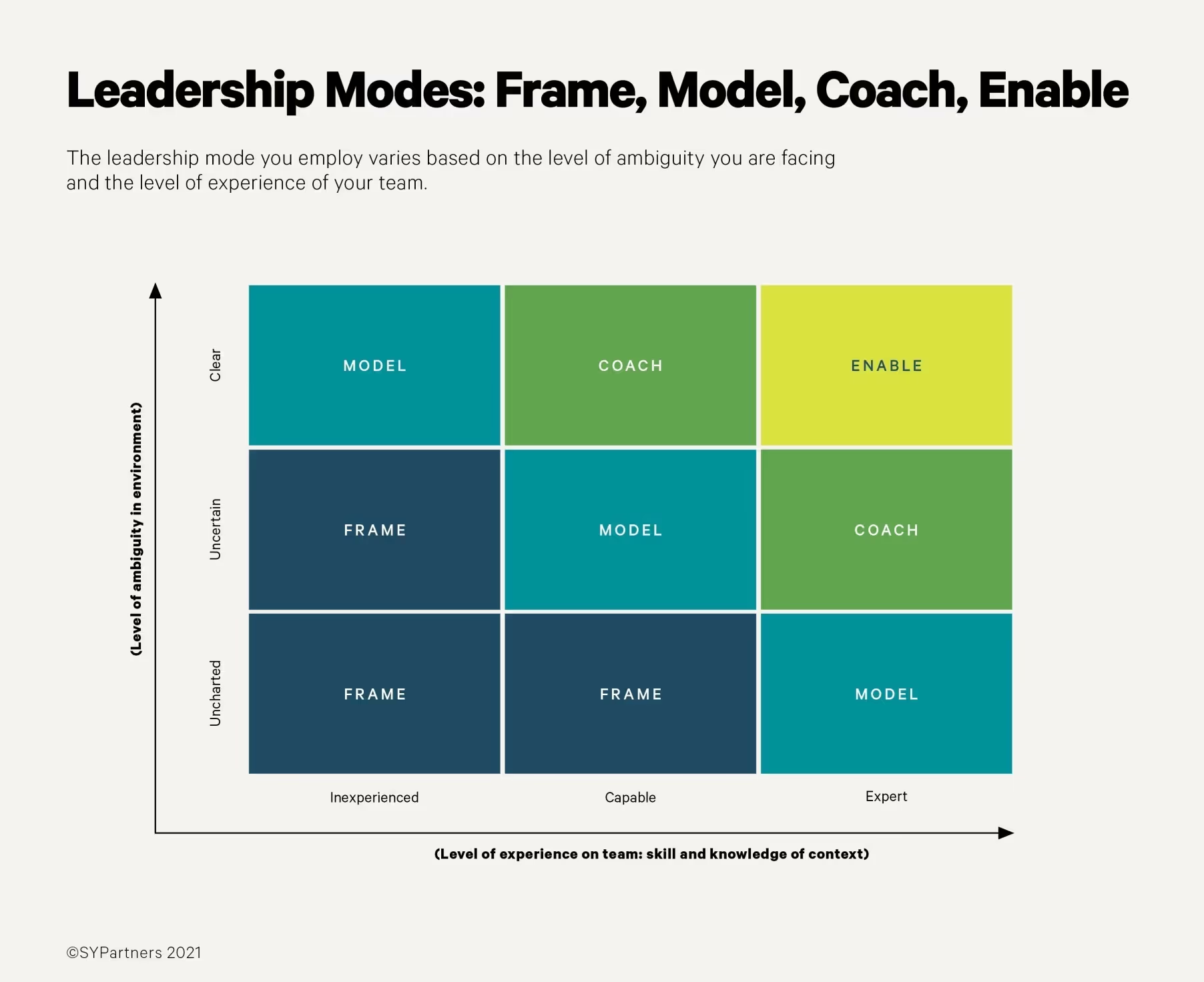
Not all situations require the same leadership mode. Part of being a successful leader is identifying what your people need, and when. When you are leading a brand-new team in a novel context, you will need to be much more hands-on than when your team is tenured and working through a familiar challenge. Of course, none of this is a perfect science.To make the “frame, model, coach, enable” framework more practical and applicable, SYPartners has created a matrix comparing ambiguity and team experience to help identify the best leadership mode for different situations.
Making this leadership model work for you isn’t easy. Hybrid work has only made it harder to accurately evaluate the full context around a project and how your team is really feeling. The key is thoughtfulness and foresight, starting with reflecting on the appropriate mode for the moment—frame, model, coach, or enable. Then it requires open conversation with your team about how you plan to show up, why, and pivoting modes if circumstances change. In doing so, you help expand their vocabulary beyond doing or escalating, and encourage them to come to you for help when needed without feeling like they have failed. More importantly, this approach enables your team to develop professionally, constantly building their capability to handle increasingly complex challenges.
So the next time you see your team spinning or stuck, stop yourself from immediately diving in. Instead, take the time to consider what approach might be best in order to meet them in the moment they are in. You may be amazed by the impact you can have without ever needing to dust off your superhero cape.
For a library of free worksheets and digital tools to help put these leadership modes into practice, go here.
More MOMENTUM
Navigating the shift from founder-led to founder-inspired
Leadership succession is an opportunity to strengthen—not replace—a founder's legacy. By distributing decision-making, codifying culture, and creating shared ownership, organizations can preserve what made them successful while building resilience for the future.


Zero-gravity leadership in the Age of AI
Leadership is being reshaped as AI rewrites how organizations operate. Informed by executive conversations and SYPartners’ research and client work, this perspective outlines the capabilities leaders need now, with a full report available to explore further.

Collective leadership: The operating model for modern executive teams
Collective leadership is reshaping how high-performing organizations operate. As complexity grows, leadership must move beyond hierarchy to enable faster decisions, stronger alignment, and shared accountability across teams. Organizations that distribute leadership behaviors across functions are better equipped to perform at enterprise scale.