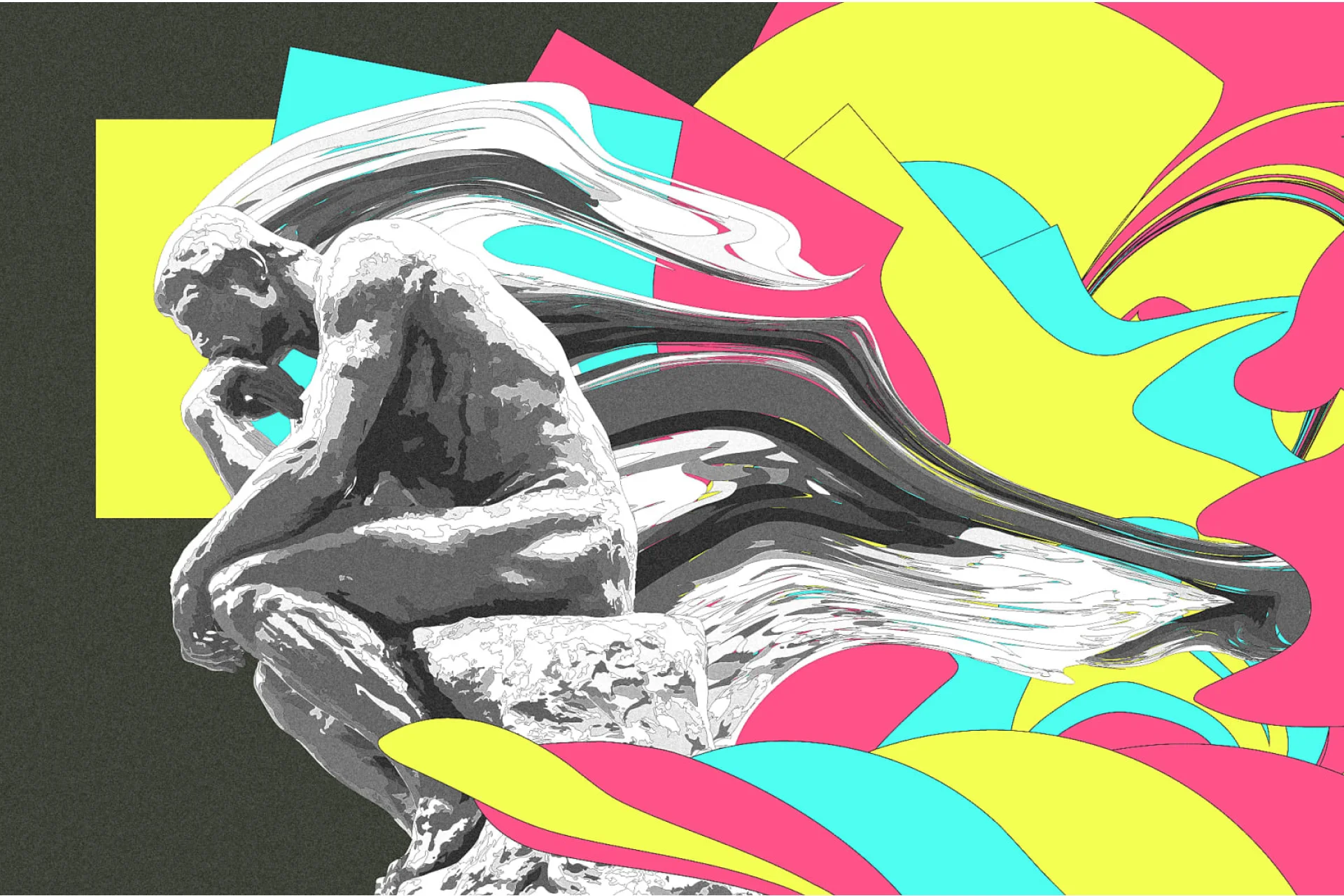
Between image and reality: How we all perceive the world
In an era shaped by images, narratives and belief, the line between truth and fiction has grown increasingly unstable. This article explores how perception, imagination and design shape what we accept as real—and why restoring clarity and responsibility in communication is essential to understanding the world we share.
There are two men in a hospital, on opposite sides of a room. They can’t see each other, but they’re close enough to speak. Weeks go by. One man describes a view outside a window to the other: white clouds, blue skies, cardinals flying by. The man listening starts to get envious—he does not have a window, only a blank wall in his field of vision. The man describes the changing views: fantastic windstorms, sunsets, rain showers, until he is well enough to leave the hospital. The man by the blank wall begs to be moved to the other’s bed, to see the view he has been told about. But when he’s moved, he discovers there is no window. There never was. What the man described was only his imagination. The creation of imagery had no reality to support it.
In between
The way we perceive the world is more fluid than the binaries of fact and fiction. Throughout the course of each day, we are confronted with continuous feeds of imagery, language, and experiences—some verifiable, some invented, many in between. The distance between the author and the reader has increased into abstraction. On an individual level, many of us select representations of our lives on social media, curating what we want to enforce as an image of ourselves to friends, colleagues, strangers, and perhaps most importantly, to ourselves. On a larger scale, history functions as a filter that presents a single image—a limited and reductive version of our shared past.
“Post-truth” was declared the Oxford English Dictionary’s 2016 international word of the year. Consider the recent election: People in other parts of the globe, outside the United States where I write this, produced thousands of fake pro-Trump news articles, which were shared millions of times—shaping people’s beliefs, their imaginations taking flight. The feeling of truth, our desire for something to be true, and our belief in an image we want to be true has eclipsed the idea of truth itself. Reality, with its complexities, contradictions, and challenges, limps to the back of the class, drooping its head, waiting for a dunce cap. It has lost its significance.

Think of one of the most basic, functional expressions of design: the bathroom sign icon indicating two defining genders. It is now loaded with ammunition, specifically in the state of North Carolina, where legislation has been passed to ensure transgender people use only the bathroom corresponding to the gender on their birth certificate.
The idea that someone defined as male by authorities now identifies as female has caused outrage. Arguments were made and clung to, including the claim that male pedophiles dressed as women would assault “real” women. Yet reality contradicts this image of predators. The National Center for Transgender Equality, the Human Rights Campaign, and the American Civil Liberties Union report no statistical evidence of this type of violence. However, the conflict between how we see a person in front of us and the visual depiction of how that person “should look” is so powerful it can lead to chaos—even death. It is a conflict of intolerance.
***
A defining theme of the Trump campaign was fear of Muslims—their implicit ties to terrorism and the safety of the country. There are about 1.6 billion Muslims in the world, roughly 23% of the human population. Fewer than 100,000 people, a report by the Bipartisan Policy Center estimates, are fighting for jihadist causes. This is 0.0000625% of the Muslim population. To understand that incomprehensibly small figure, multiply it by 1,000 and it’s still only 0.0625%. The chances that an American will die as a result of terrorist activity is approximately one in 20 million—the same statistical likelihood that you will die by being crushed under your sofa.
Despite these exceedingly low statistics, we are saturated by images of fear, bloody violence, and terror. This plays effectively to how our minds respond to threat. Imagery of violence not only produces stronger emotional reactions but dominates news—and therefore our consciousness. This falls into what psychologist Daniel Kahneman calls an availability cascade: a process of belief formed by both the ease with which an image comes to mind and its volume of availability. When information or imagery is repeated over and over, regardless of actual risk, it becomes the most real and the most urgent.

Statistically, we’re most likely to die from something much less dramatic: heart disease, a condition caused by thousands of decisions, genetics, and history. But there is no immediate image of its threat. What if funds to combat terrorism were redirected to what is statistically our most likely cause of death? Or imagine banning sofas because of their analogous capacity to kill us.
***

Several months ago, I was invited by The Church of Jesus Christ of Latter-day Saints to join a panel discussing how designers can thrive within the confines of an established brand. It was part of a celebration of the church’s first brand guidelines. My thesis was simple: For a brand to thrive, it must strike a balance between consistency and variation. Think of Nike, Apple, or Google, allowing for evolutions based on clients, audience, and even designers. Because the church does not sell a corporate product, I used a cultural example—the rainbow flag. Its visual evolution documents how acceptance and understanding of the LGBTQ community has changed over time. It was three minutes of a 15 minute presentation.
I sent the presentation to the organizing team for technical review. They asked me to remove the section about the flag because it could be perceived as a provocation. I explained that as a designer, it was important to use a cultural symbol that demonstrated visual evolution. If it could not be viewed as such, perhaps I was not the right person for the panel. The organizer agreed, and I was removed from the discussion. The images—and the realities they represented—were deemed too distracting.
***
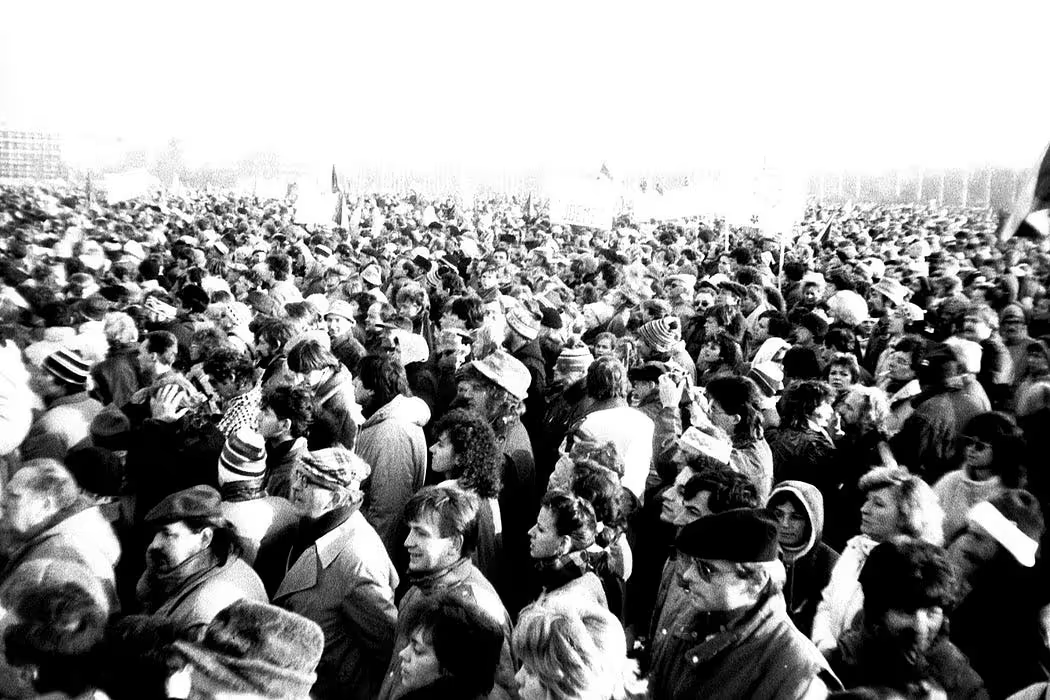
On Nov. 17, 1989, the people of Czechoslovakia began a movement to overthrow their government, later known as the Velvet Revolution. Through passive resistance, hundreds of thousands ended a 41-year Communist rule. The movement began with a student march of about 15,000 people. As word spread that a student named Martin Šmíd had been killed by police, demonstrations grew to more than 500,000 people. A week later, the Communist Party leadership resigned.
What people did not know—or could not accept—was that Martin Šmíd never existed. Both his life and death were fiction. Yet the image of his death helped fuel one of the largest peaceful transfers of power in history.
***

Our imaginations are born from our pasts, our presents, our hopes, our desires, our heartbreaks — creating a unique vantage point. Each of us brings this landscape of our lives to how we see and perceive the world. We each see through the lens of the most significant frame: our own identity. To ignore this is to ignore the reality of being human. We are entering an era promised to “Make America Great Again,” a phrase which sets our imagination free with images of a preferred life, a better life, to whatever is now. It is a phrase we could all translate to mean: “Make my life great again.”
One thing that we all have in common now is this: We exist in an untethered, cavernous space between image and reality, selecting bits and pieces of information to complete a picture of what we want to be real. If a piece doesn’t fit, if it challenges our beliefs or what we desire to be true, we can always discard it for one that supports what we want to see. While this is not a new behavior (the chapter preceding our "post-truth" world could not be called "truth") it is now front and center on the world stage, encircled by spotlights.
Truth, fiction, and the fuzzy space between can all look the same, especially through digital media. What we see and read is always supplemented by our imaginations, just as bricks need mortar to complete a building. In order to get out of our individual frame—our default setting, as David Foster Wallace referred to it —we can challenge our assumptions and beliefs through education, evidence, and experience.
This elevates everyone’s responsibility in communication, specifically a designer’s. Our ability to bring shape to information, clarity to an idea, and form to a fact is the most important contribution we can bring to our world.
The role of design has never been more important in our quest for understanding.
“Seeing comes before words….It is seeing which establishes our place in the surrounding world; we explain that world with words, but words can never undo the fact that we are surrounded by it. The relation between what we see and what we know is never settled.”
— John Berger
More MOMENTUM
The beauty of an unspoiled mind: 4 creative benefits of practicing not being an expert in your field
In a world built on best practices and proven frameworks, creativity can narrow under the weight of expertise. Original thinking requires the discipline to question assumptions, trust intuition and resist defaulting to what is already known. Protecting an unspoiled mind creates space for courage, imagination and new ways of seeing.

What Milton Glaser reveals about the limits of rational design
Designers have become too reliant on focus groups and past successes, often looking backward instead of drawing inspiration from the world around them. Reflecting on Milton Glaser’s practice, this article examines how rational design, data and validation shape what we make—and why creativity needs space for intuition, risk and lived experience.