Why operating models fail


Growth can turn organizational scale from an advantage into a source of complexity. Strong operating models go beyond structure, connecting decision rights, enterprise capabilities, leadership behaviors, and incentives so organizations can execute strategy more coherently, adapt as priorities evolve, and perform at scale.
Every successful company eventually reaches an inflection point where growth stops creating leverage and starts creating drag. As businesses, functions, and geographies become more interdependent, decisions slow, enterprise capabilities fragment, and leaders spend more time coordinating than creating value. Employees become less certain about where decisions belong, whose priorities take precedence, and when they are empowered to act. The organization responds with more meetings, additional governance, more approvals, and more escalation—each intended to create clarity, but often adding complexity instead.
Eventually, the conclusion is the same: The operating model needs to change. A strong operating model clarifies where decisions belong, how resources are allocated, and how different parts of the enterprise work together. This enables the organization to make better decisions, build capabilities faster, adapt more easily, and create more value from the scale it already has.
Yet operating model redesigns often produce far less improvement than leaders expect—not necessarily because the strategy is wrong or the formal structure is poorly conceived, but because organizations redesign how work is supposed to happen without redesigning how work actually happens.
Operating models fail when organizations redesign structure without redesigning how work gets done.
Across industries, company sizes, and ownership models, we’ve yet to see structural redesign alone produce the performance leaders were seeking. Structures, reporting lines, decision rights, and governance evolve, but many of the problems that justified the redesign—such as slow execution, duplicated investment, inconsistent customer experiences, and fragmented enterprise capabilities—slowly return. Organizational habits prove remarkably durable.
These four recurring patterns help explain why.
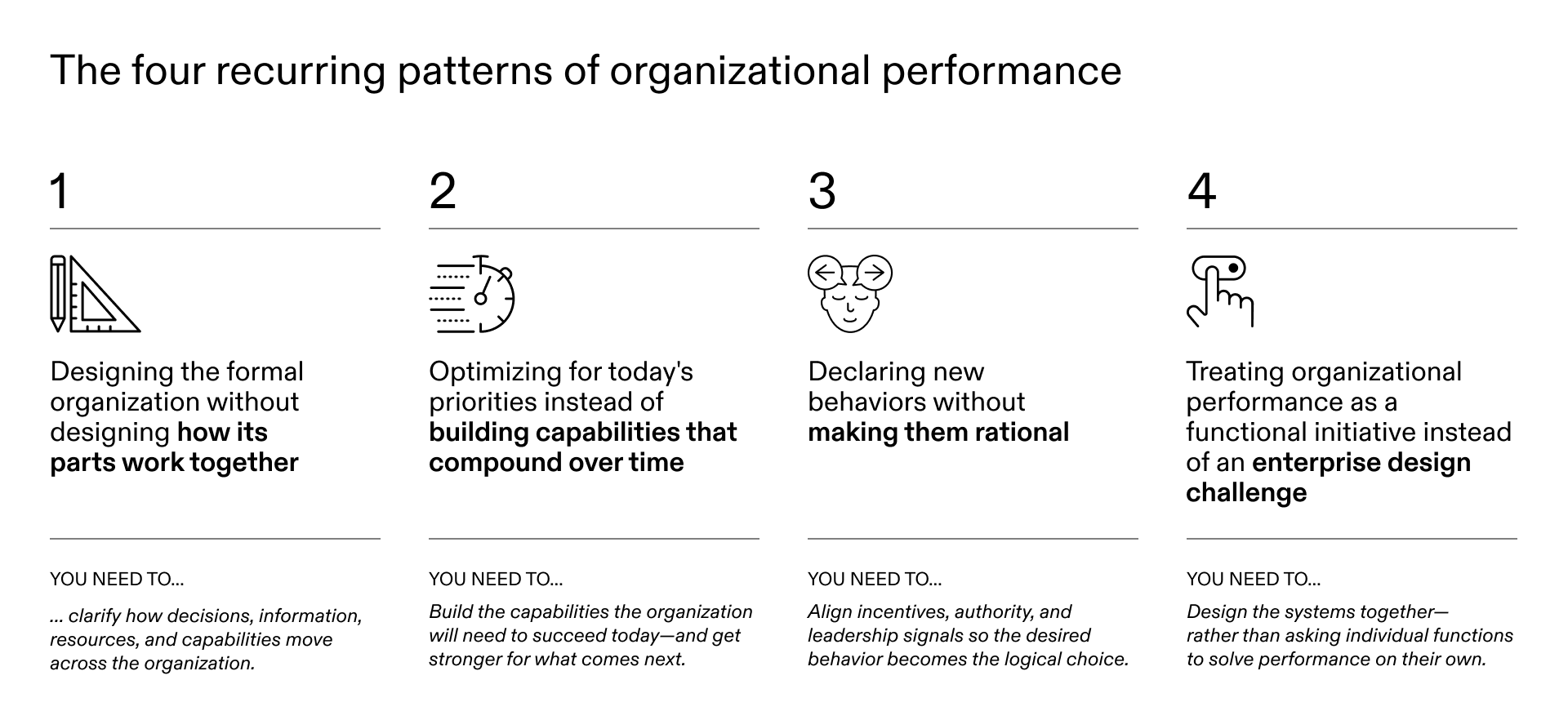
Operating models succeed when leaders design more than structure. They require a connective system that enables the enterprise to function as one, strengthens capabilities as strategy evolves, and makes desired behaviors more rational through aligned authority, incentives, consequences, and leadership signals. Because these elements work as an integrated system, activation must be owned as an enterprise responsibility—not delegated to any one function.
Pattern 1: Designing the formal organization without designing how its parts work together
Reorganizations rarely stay reorganized because an organization is more than its formal design. Every company has both a formal and a lived operating model. The formal model consists of the structures, accountabilities, processes, and decision rights captured in organizational charts and governance documents. The lived model is the network through which authority, information, expertise, and influence actually travel.
Your “operating platform” is what connects those two: the shared logic, mechanisms, and infrastructure through which the formal organization becomes a functioning enterprise. The operating model defines where accountabilities and decisions are intended to sit; the operating platform determines how information, authority, capabilities, and resources move across those boundaries in practice.
This helps explain why so many reorganizations feel simultaneously significant and strangely familiar. Organizations redraw reporting lines in weeks while leaving the pathways through which work actually moves largely intact. The chart changes overnight, but critical dependencies still run through the same leaders, information remains concentrated in the same places, and cross-boundary work continues to depend on informal relationships. Decisions require the same negotiations, capabilities still struggle to cross boundaries, and senior leaders remain the primary mechanism for resolving interdependence. The organization has changed its visible architecture, moving the boxes without redesigning how they connect.
At one global healthcare company, a matrix structure was put in place to help preserve oversight through a major transition. As the company scaled, the mechanisms for navigating shared, cross-functional work were never clearly designed: functions pursued competing metrics, teams escalated rather than solved problems together, and employees learned to work around the system in order to get things done.
An operating model is only as effective as the connections between its parts.
A well-designed operating platform changes the economics of scale. Instead of every new dependency requiring more coordination, it creates reliable pathways through which decisions, capabilities, information, and strategic intent can travel without constant executive intervention. Executive attention is often an organization’s scarcest resource—and the operating platform determines how much of it is focused on the day-to-day running of the business versus longer-term strategic priorities.
The result is an organization that requires less effort to execute, scales enterprise capabilities more effectively, and converts growth into performance instead of complexity.
Pattern 2: Optimizing for today's priorities instead of building capabilities that compound over time
Operating models optimized for a moment in time quickly become obsolete. Much of today’s operating model thinking was developed for a different competitive environment. When strategy evolved relatively slowly, leaders could determine where the company would compete, organize around those choices, and optimize the structure for execution. That logic is becoming harder to sustain as technologies, customer expectations, and competitive advantage evolve faster than planning cycles.
The challenge is no longer simply to align the organization to today’s strategy, but to continually strengthen the enterprise capabilities that will differentiate it tomorrow.
The most durable operating models are designed less around today’s business configuration than around the handful of differentiated enterprise capabilities the company intends to become progressively better at over time—like customer insight, commercial execution, product development, AI integration, or capital allocation. Products, markets, technologies, and business models may evolve, but these high-value capabilities should strengthen with every business decision.
The best operating models improve the organization’s ability to execute the next strategy.
The organizations we've seen navigate this well rarely converge on the same answer. Some strengthen enterprise mechanisms across highly decentralized portfolios. Others deliberately preserve local autonomy while creating greater consistency around the handful of choices that truly define the enterprise. The aim is enterprise coherence (not uniformity): enough shared logic for the organization to move as one where it matters, while preserving the autonomy that creates competitive advantage in distinct local contexts.
We saw this at a global consumer company whose increasingly diverse portfolio could no longer thrive under one uniform culture. Rather than standardize, it defined a shared foundation and the few spaces where businesses needed to connect, while giving each business room to shape the culture its context required. The result was coherence without uniformity: a common identity that preserved local advantage. This closely reflects the house-of-cultures model.
The payoff is strategic adaptability without organizational drift. The enterprise evolves, but the capabilities that create competitive advantage become stronger rather than more fragmented.
Pattern 3: Declaring new behaviors without changing what makes them rational
Across transformations, we’ve yet to see leaders and teams adopt new decision patterns simply because the organization announced new ways of working. Behavior changes when the incentives, consequences, authority, and leadership signals surrounding a choice make the new response more rational than the old one.
The pattern is remarkably consistent. Leaders call for “enterprise first,” “decide at the right level,” or “collaborate across boundaries,” while preserving the signals that made the old behavior rational. A leader cannot consistently prioritize the enterprise if every performance measure rewards the success of an individual business. Teams cannot make faster decisions if authority remains ambiguous or senior leaders routinely reopen choices after the fact. Functions cannot collaborate effectively if planning, funding, and talent decisions continue to reinforce separate agendas. The organization asks for one set of choices while continuing to confer status, resources, and security on another.
The contradiction between stated and reinforced behavior was especially visible inside a global healthcare company trying to accelerate decisions. Leaders kept telling teams to move faster, but employees saw decisions questioned or remade unless they were supported by exhaustive analysis and broad pre-approval. People rationally responded with overpreparation, oversized meetings, and escalation—slowing the very decisions leaders wanted to speed up.
Every operating model eventually becomes whatever the organization rewards.
The alternative is to change the conditions surrounding recurring choices so that the intended response becomes easier, safer, and more credible than the old one. Those conditions vary by organization, but often include decision frameworks that resolve recurring trade-offs, performance measures that reinforce enterprise outcomes, leadership routines that model the intended distribution of authority, consequences for reopening settled decisions, and experiences that allow leaders to practice operating differently before the stakes are high.
Too often, executive teams treat these conditions as downstream implementation details. In practice, they determine whether the new operating model survives contact with real choices. When performance signals, authority, consequences, and leadership behavior reinforce one another, people can make strategically aligned decisions without repeatedly seeking permission, protection, or interpretation from above.
Pattern 4: Treating organizational performance as a functional initiative instead of an enterprise design challenge
Across organizations, operating model work follows a surprisingly consistent trajectory. It begins in strategy, passes through organizational design, and is eventually handed to HR, technology, operations, and communications for implementation. That sequencing almost always widens the divide between the performance outcomes leaders originally intended and the organization that employees ultimately experience.
A global consumer company we worked with started their operating model redesign as a centrally-led effort focused primarily on where work should sit. Leaders soon recognized that it would not take hold unless they also redesigned decision rights, cross-enterprise interactions, and leadership behavior. They broadened ownership across businesses and functions, turning a structural exercise into a shared enterprise transformation.
A new operating model simultaneously changes how strategy is translated, how leaders exercise authority, how talent moves, how information flows, how technology enables work, and how people experience the organization. Organizational performance emerges from the interaction of those systems, not from any one of them in isolation.
Organizations are designed on paper. Performance emerges from systems.
Assigning the operating model to any one function almost guarantees that it remains a design on paper rather than becoming a platform for performance. Activating it requires the leaders accountable for enterprise results—not only those responsible for organization design—to jointly shape the decision rights, management routines, capabilities, and behaviors that determine how the organization operates. Without that shared ownership, performance is constrained less by the quality of the strategy than by the organization’s ability to execute it consistently at scale.
Designing an organization that can keep evolving
The purpose of an operating model is to create a higher-performing enterprise—one that requires less coordination to make sound decisions, scales capabilities across boundaries, and adapts as strategy, markets, and technology evolve. Its success is measured not by the elegance of its design, but by whether the organization consistently makes better decisions, strengthens enterprise capabilities, and translates strategy into performance with less executive intervention.
That requires leaders to ask a different set of questions:
- How do the different parts of the organization need to work together to create greater value as one enterprise?
- Which capabilities must continue to strengthen as the strategy evolves?
- What will make the desired behaviors the easiest and most logical choices?
- Which leaders must share responsibility for the systems that shape how the organization performs?
The highest-performing organizations we’ve seen don't eliminate complexity—they change how it behaves. They build operating platforms that make the logic behind decisions widely understood, allowing the formal and lived operating models to reinforce one another instead of working at cross purposes.
Most organizations redesign their operating model every few years in search of better performance. The ones that win continually strengthen the operating platform beneath it. Over time, that becomes a competitive advantage in itself: an organization that executes more coherently today while becoming better prepared for whatever strategy comes next.
More MOMENTUM
The CHRO role has outgrown HR
The CHRO role has expanded with every new disruption to the workforce. As expectations continue to grow, CHROs have an opportunity to move beyond traditional HR and shape the human systems, capabilities, and culture that will carry the enterprise forward.


The hive imperative: Why experience design is a business strategy
In periods of rapid change, organizations need more than efficiency to adapt and perform. Experience design builds trust, strengthens collaboration and helps teams align around a shared vision, creating the collective capacity required for lasting transformation.