The hive imperative: Why experience design is a business strategy


Organizations facing disruption and accelerating change need more than efficiency to succeed. Thoughtful experience design helps teams build trust, strengthen collaboration, and align around a shared vision. By creating meaningful moments of connection, organizations can unlock collective potential and make transformation more resilient and enduring.
You and I are 90% chimp and 10% bee.1
We mostly operate in an individual context; it is our default lens in the world. (You do you; I’ll do me.) However, that 10% of "beeness," which resides within all of us, means we have the capacity to work in a hive, forming a kind of superorganism to think more boldly, to move more quickly as a group, to fortify shared ambition.
To navigate the myriad changes organizations are facing—the promise and challenge of AI, the uncertainty of geopolitics and what some say is the end of predictable progress—requires the power of a superorganism to move forward together..
Superorganisms are formed through shared experiences. When we experience something as a group, our brain chemistry changes. We produce oxytocin, which bonds us, aligns us and strengthens our collective potential. Our mirror neurons help us map and feel what others feel, observed through their actions, intentions and expressions.
We are evolutionarily wired to work together, in the formation of a superorganism.
How experience design improves organizational performance
Intentionally designing experiences for how groups, organizations, and businesses navigate change is not superfluous. For a workforce, it unlocks collective potential and improves organizational performance, especially during moments of profound change. While much of the world is moving towards efficiency, slowing down (however briefly) to meet and work together fortifies the elements of transformation.
We see this tension playing out in real time: Clients increasingly ask to optimize their offsites for maximum efficiency, packing schedules to the minute in an effort to produce the most value. However, the value is often not in the quantity of topics covered or the amount of slides presented. The value is increasing the capacity of teams to perform together, innovate and navigate the precariousness of this moment through becoming a superorganism.
This reality is demonstrated through a MIT Center for Information Systems Research study, which isolated the business impact of intentional experience design (defined as “proactive intervention of a company’s work environment”). Companies that designed intentional experiences for their employees unlocked group habits and fostered deep trust. Companies that had rigid, process-first ways of working had lower innovation and adaptation rates.
Why is that? A transformational experience enables human beings to pay attention, to see differently, shift perspectives and open their hearts and minds to new possibilities. Experiences help peoplen see, believe in, understand and commit to a new vision— and understand how to work together, as a hive, to get there. Without intentionally designing how people experience organizational change, transformation is less sturdy, more brittle and fragile.
Experiences that truly change us rely on senses outside of what our typical screen ratios allow. The best experiences activate both hemispheres of our brains: our left for the intellectual rigor, and our right to develop our emotional relationship to the work ahead. We do not simply think our way into change, we feel our way into it.
Transformational experiences combine the familiar and unexpected. They use strategic discomfort to create impactful results for your teams and organizations. They reaffirm bonds between people as a means of building common cause towards collective action. They cause us to pay attention in a world where our focus is degrading.
In the 300,000 years of our species, we still need to operate as a group—as bees form a hive to cooperate, bond and, ultimately, act as a collective superorganism.
Tenets of Experience Design and relevant examples
To design experiences that transform individual people into a superorganism, deprioritizing our individual nature, SYPartners holds the following principles.
Prioritize human connection
Some might think of human connection as an inefficiency, as there is not always a neat line (or a metric to measure) connecting a shared feeling to business performance. But teams achieve the best outcomes when the people in them feel open and connected to one another. Getting there is not just about focusing on “the work” but on fostering trust and safety within relationships in order to work well together.
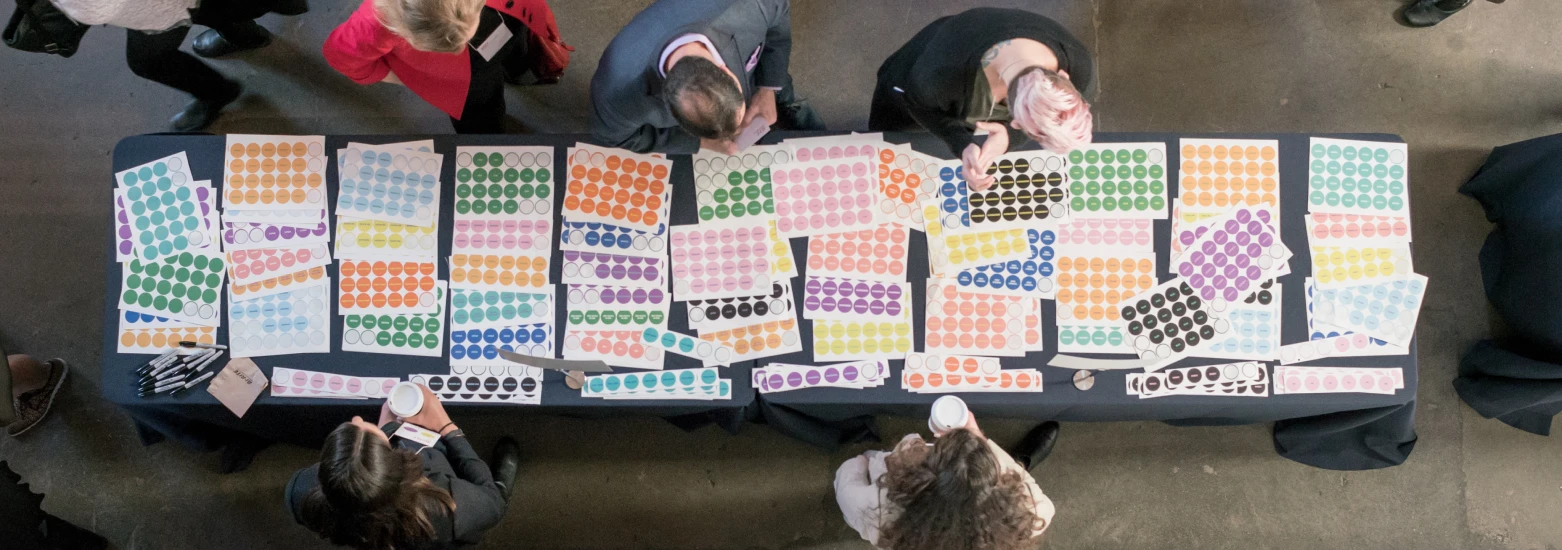
Small moments in the design of an experience can foster this connection, even among people who have never worked together before. For one leadership conference SYPartners created alongside Rich Talent Group, we accelerated connection by asking event participants to share invisible characteristics of themselves by placing descriptive stickers on their nametag. Making this the first thing people did when they arrived set the expectation that participants would be prompted to see each other more fully; it sparked conversation and connection from the start.
Designing for human connection can take many forms; another powerful way it happens is through the simple act of making something together. This helps in two ways: It allows people to digest and understand content more deeply, and it produces a feeling of belonging for participants that they are part of a team, which makes them feel more invested in the success of what they have made.
As one example, SYPartners was asked to develop a large-scale onboarding program for a company that was experiencing rapid growth. A primary goal was to design for belonging, to create a space for people to feel as if they belong there as quickly as possible.
As part of the weeklong experience, we organized cohorts—groups of four or five people would move through the week as a small team. Recognizing that co-creating helps engender a feeling of connection and belonging, we asked each cohort to create a video by the end of the week. Their brief was to describe the company as they might to a friend at a summer barbecue. Positive feedback was effusive: The onboarding program was ranked highly upon launch, and participants shared that the creative act made them feel proud and bonded to their team. Creating the video collectively had a practical outcome, too: It helped everyone digest the basics of the company and gave them a shared memento that could also be scaled throughout the organization.
Balance what is expected vs. unexpected
Transformative experiences are thoughtfully designed to disrupt people’s expectations with intention, care and structure. When something happens unexpectedly, it causes people to pay attention and retain a memory of the experience as a reference point.
Of course, it has to be the right amount of unexpectedness. The experience must be interesting enough to be engaging, but not so outlandish as to be inaccessible.
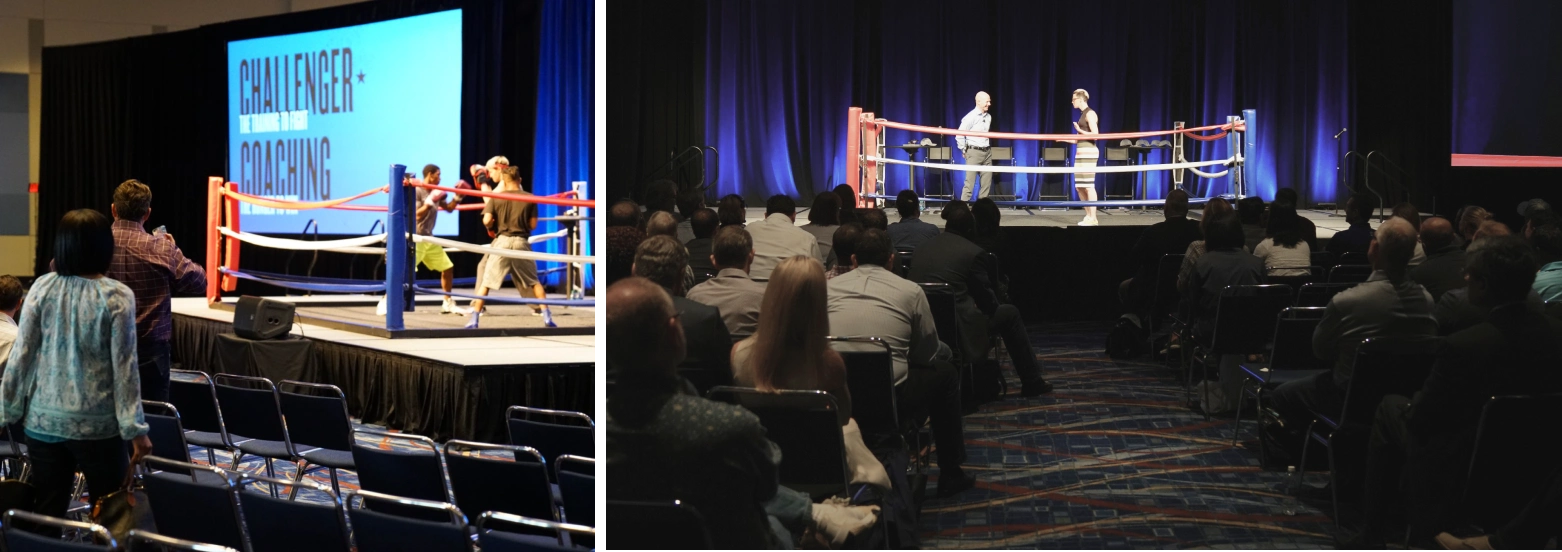
For one global technology company’s two-day sales training session, the objectives were to focus on new selling techniques and inspire a culture of tenacity. We adopted a boxing metaphor as the central idea, aligning the agenda, objectives and training-specific content around that central theme. It informed the physical design of the space, utilizing a boxing ring as a stage.
When attendees came in with their rolling suitcases, they saw young fighters in the ring, sparring with their coach, with music blasting. It felt more like a gym than a conference hall, setting the tone for the event. The entry experience conveyed, “Pay attention! This is not your average training session!” and created place-based memories to fortify the objectives and agenda. We received consistent feedback that the two-day session was the best training participants had ever attended—both practically because they adopted new rituals and tools to improve selling, and relationally because of how they learned to work together. Performance of this particular team increased significantly in the months that followed, setting an example for its sister global teams to emulate.
Create emotional impact
People need to feel differently before they think differently—and act differently together. Our work addresses emotions as a stimulus for change.
Businesses tend to be the territory for the rational and intellect, but designing moments that introduce new feelings can shift what teams believe and, therefore, how they think and act. This is where artful experience design is necessary. In a business context, too sharp an emotional note might cause people to resist or retreat. But provoking people’s feelings to the right degree opens their (hearts and) minds to new ideas.
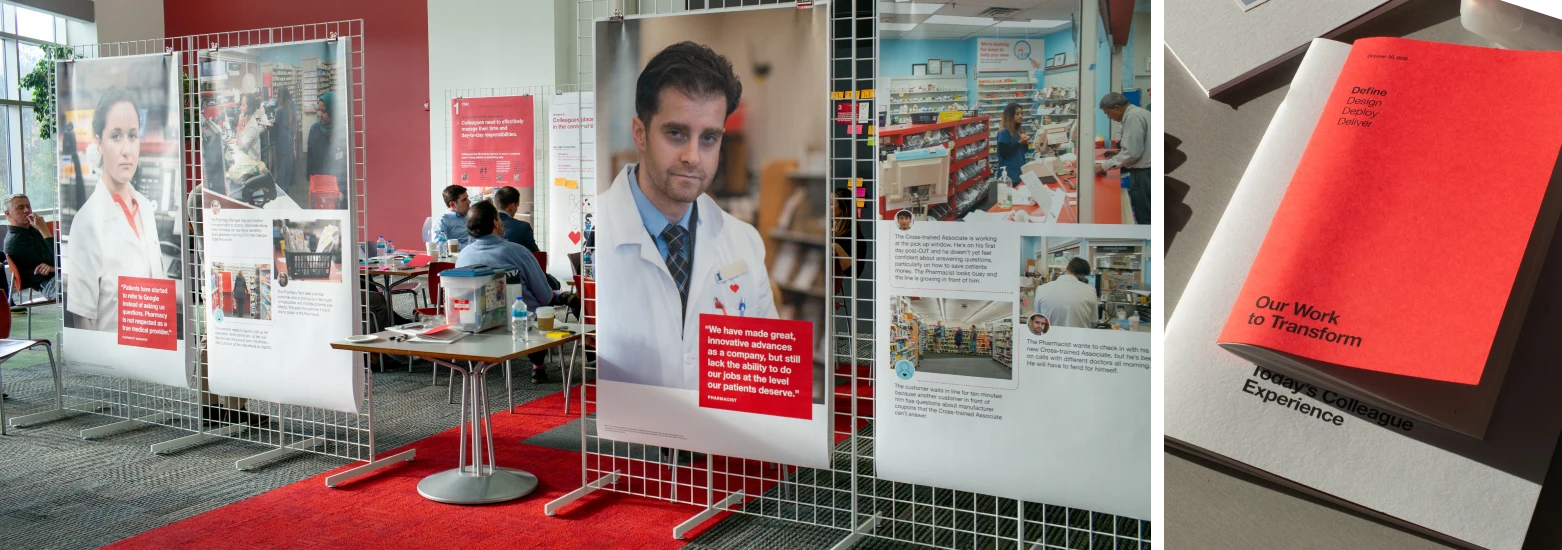
For instance, when we partnered with an executive team of a large national retailer to help in-store colleagues better deliver on their purpose, we created a set design of the store to best express the challenges in the front line. It contained large portraits of employees, and mini ‘scenes’ of everyday challenges, complete with a soundtrack that played in the store. After the executive team came into this custom immersive experience, team members noted that they had known about the issues in-store but had never “felt” them. That was the impetus for this team to create change. Ultimately, the company was inspired to create a new department to focus on in-store employee experience, helping the organization move forward in a coordinated, purposeful way.
Transport people from the everyday
The environment around us—our physical context—is a key factor shaping how we relate to information and orient our disposition to the subject at hand. Taking people out of their routine environments is one of the most impactful ways to change how people think and what they believe is possible.
For several clients, SYPartners has invited executives to spend a day in another role, directly experiencing the lived realities of another person in that person (a customer’s, an employee group’s) spaces and contexts. We consistently find these experiences, outside of executives’ typical rhythm, spark empathy, build trust, provide new context towards current initiatives, and help generate new strategic ideas.
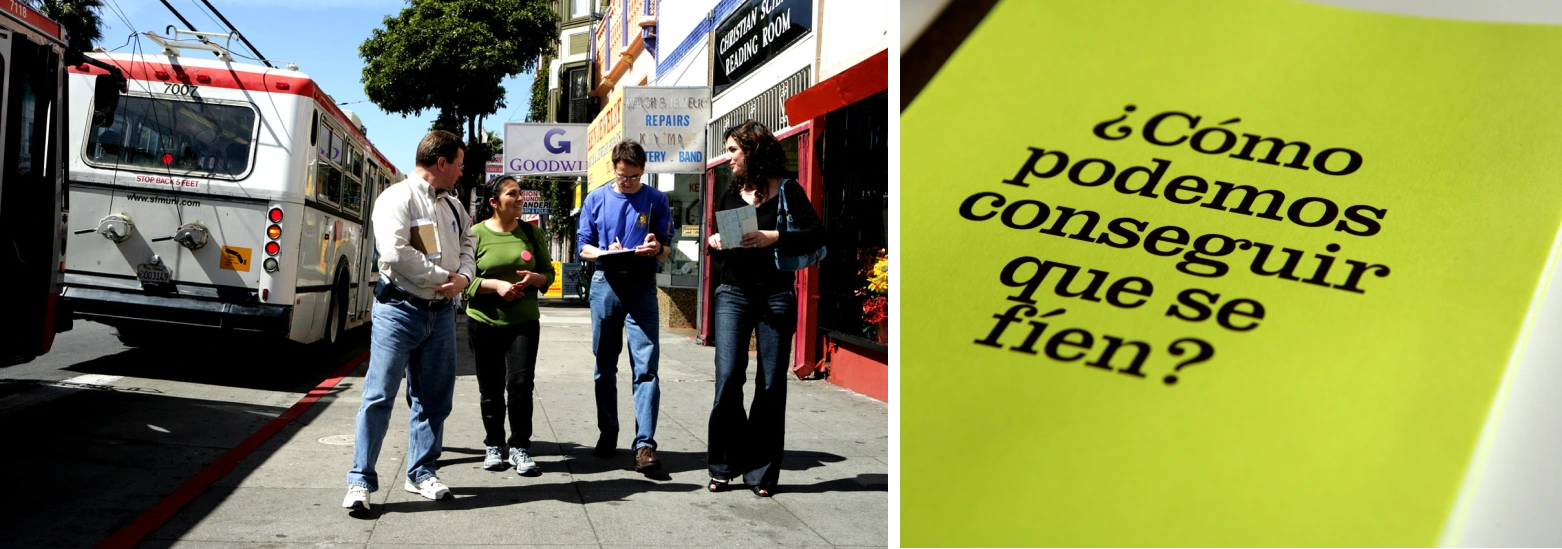
For example, a group of leaders brought together and tasked with pitching a new business inside a large multinational corporation completely changed their point of view about what new value might be possible after getting out of their headquarters city for one day and both observing and showing up as consumers in their sector. The experience was slightly uncomfortable by design: Forced proximity to consumers, needing to use translators, and reckoning with suboptimal product experiences required vulnerability. But the experience sparked ideas that were so strategically sound and bold that this group of leaders was invited to continue on together as a new team, and actually build the business they had envisioned.
Sometimes disrupting the everyday to foster new thinking is about simply changing the physical environment where work needs to happen. For one three-day leadership team offsite to develop a new vision for a client organization, we transported participants to Puerto Vallarta, far from their offices in New York City. The offsite was held at an Airbnb, surrounded by palm trees, seaside breezes and open spaces, all of which fostered a spaciousness of mind. With the space and environment for slowing down, and without the demands of their typical workdays, conversation flowed freely. Our clients were able to deeply engage in the topic and exercises and quickly align on a vision and develop a narrative of who they were and where they were going—all by leading them through the work outside their typical environment.
Use all of the senses
While physically transporting people can create a transformative experience, engaging the senses can shift someone’s perspective in an instant. Our bodies are constantly taking in cues from the environment around us—smells, changes in temperature, textures, sounds, light, physical objects and yes, even food. Whether we notice it or not, these cues shape how we feel in a space.

A recent gathering of senior leaders was held to define their organization’s purpose, necessary bold moves and cultural shifts. A key aspect of the experience was sensory design, we created multi-sensory experiences of employees sharing the breadth of their experiences—both positive aspects and challenging ones. Hearing real voices share these perspectives made the experience more real, creating new cultural insights.
Deviating from typical text and slides to share employee sentiment through data (pulse surveys, reviews, and mid-year check-ins) strikes a different register, embedding a seed of change that is hard to ignore. SYPartners embraced sensory design as a way of creating shared understanding among leaders. We created audio experiences of employees sharing the breadth of their experiences—both positive aspects and challenging ones—in spoken word. Hearing real voices share personal perspectives made the experience more visceral for leaders, deepening their insight and heightening their accountability to change things in the culture.
People are more likely to move together toward a future they can already see, feel, and imagine. In this instance and others, designing for the senses helped bridge the gap between understanding and belief. It allows teams to move beyond analyzing an idea, to begin advocating for it based on their experience of it.
Going forward as superorganisms
We’ve had the answer since the dawn of humanity nearly 300,000 years ago: Our real source of collective potential will not be found in the latest AI model or the latest efficiency trend. It is the power of thoughtful experience design to help us shift from our default “chimp mode” to “bee mode” by creating the superorganisms we need to navigate constant volatility and create new value collectively.
1. Haidt, J. (2012). The righteous mind: Why good people are divided by politics and religion. Pantheon Books.
More MOMENTUM
The CHRO role has outgrown HR
The CHRO role has expanded with every new disruption to the workforce. As expectations continue to grow, CHROs have an opportunity to move beyond traditional HR and shape the human systems, capabilities, and culture that will carry the enterprise forward.


The hive imperative: Why experience design is a business strategy
In periods of rapid change, organizations need more than efficiency to adapt and perform. Experience design builds trust, strengthens collaboration and helps teams align around a shared vision, creating the collective capacity required for lasting transformation.