The myth of one-size-fits-all culture: Why the future lies in a house of cultures


As businesses grow more complex through acquisition, globalization, and deregulation, culture becomes a decisive differentiator. A single, uniform culture can no longer meet competing needs. This article introduces the “house of cultures” model, offering leaders a way to balance shared identity with meaningful cultural distinction.
An expected wave of unprecedented deregulation in 2025 will dramatically transform business. An unleashed corporate sector will speed consolidation and exert even greater pressure to compete through differentiation. For acquirers as well as legacy businesses, culture will mean the difference. Nearly all leaders (95%) agree culture is critical to acquisition integration, yet 30% of mergers and acquisitions fail to meet financial targets due to cultural issues (McKinsey, Organizational culture in mergers: Addressing the unseen forces, 2019). For established businesses, more than half of HR leaders name culture as the most significant barrier to transformation (Mercer, "Culture Risk in M&A"). With the emergence of even more complex and multifaceted businesses, the human factor—culture—is more essential than ever.
Traditionally, organizations have found value in codifying what is uniquely great about their culture and reinforcing that uniqueness through values, rituals, ways of working, programs, and norms applied across the entire organization. Some even consider this singular culture the foundation of competitive advantage. The fact is, even organizations renowned for their iconic cultures and admirable balance sheets are increasingly composed of multiple cultures. Businesses consolidate to compete globally while staying agile and resilient in a volatile environment. Distributed and global workforces further decentralize culture. The evolution of modern business makes a house of cultures natural and inevitable—something not only to embrace, but to encourage and design.
The more well-known concept of a house of brands describes an architecture in which each brand stays unique and distinct, tied together simply by a shared owner. A house of cultures provides structure and guidance around strengthening a shared cultural identity while celebrating and supporting cultural distinctions across associated businesses. It requires intentionality—specifying which elements of culture are shared, by whom, and clarifying the degrees of freedom each business has to design and own them.
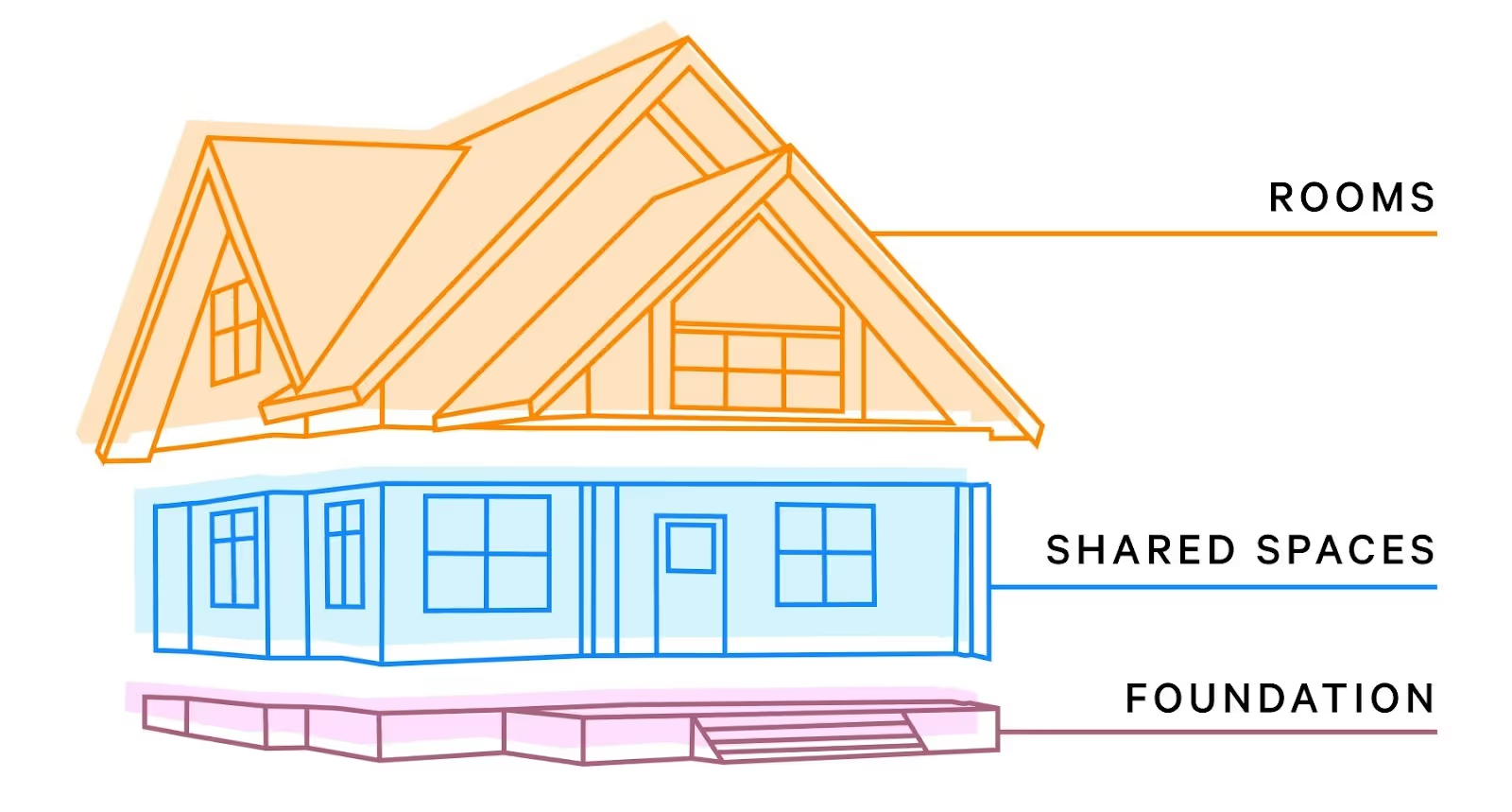
For leaders designing organizational culture, it helps to think in terms of a house’s architecture:
- What unites the organization: The foundation is the common defining feature that conveys the few evergreen values uniting the organization. It includes cultural nonnegotiables and shared beliefs—purpose and values—without which there would be no reason for these businesses or teams to associate.
- How employees come together: Shared spaces—the kitchen, den, or atrium—are where businesses intentionally interact to strengthen fundamentals. This is the unique differentiator of an intentionally designed house of cultures and one many organizations overlook. Shared spaces may include shared services, employee communities, or organizationwide efforts that foster learning, collaboration, and access to best-in-class capabilities.
- How the organization is organized: Rooms are distinct spaces that respect and uphold the unique culture of each entity. These rooms must remain modular and dynamic, reflecting today’s business and its future evolution. Each room declares what culture means to it, creating distinctions that strengthen the whole through shared learning.
What house archetype best suits your aspirations and existing structures?
In designing a house of cultures, it’s important first to get clear on the ways in which the house needs to work and which architecture best suits the organization’s needs. Like most houses, having a foundation and shared spaces is the baseline for building a thriving house of cultures. The individual rooms are the space where you have the greatest opportunity to customize and design the right subcultures. To make the most of that opportunity, your first step is to identify which archetype—or combination—best matches your business strategy and organizational needs.
Function
Companies that are less distributed and have a deeply unified culture are often still differentiated by function. In small companies, being culturally differentiated by function allows each team to operate in a way that aligns with its specific goals and responsibilities while maintaining the company’s overall values. A high tolerance for risk-taking can be desirable in marketing, but not finance, for example. Design this house if...
- Your business is centralized in one location.
- All employees work in service of a shared product suite or offering.
- Your talent strategy requires attracting people with unique function-specific skills.
Geography
Geographically distinct company cultures allow for a degree of global consistency while maintaining local relevance. Norms and mindsets that may seem rational in one region could be unacceptable in another. These companies ensure their values resonate both globally and locally to foster engagement and success across different cultural, economic, and regulatory environments. Design this house if...
- Your business operates in multiple regions around the world.
- Your customer base varies widely by region.
- Your offerings need to be tailored to specific market needs and requirements.
Business unit
Many companies organize their cultures through natural divisions within the enterprise, focusing on the unique needs of each business unit. For companies that have grown through acquisition, this looks like maintaining the unique culture of each unit while fostering a shared “foundation” that unites them. Design this house if...
- Your offering varies widely across business units.
- Business units already have strong cultures that you want to amplify.
- You’ve acquired a company with an intact culture worth preserving.
- You’re organized for vertical integration and/or decentralized operations.
Business maturity
Companies organized by business maturity tailor their culture to align with the specific needs of each business unit’s stage of development. This allows them to create a more nuanced and effective cultural landscape across the organization, as growth-stage areas foster innovation and agility, while more mature areas maintain operational excellence and stability. Design this house if...
- Your business is highly acquisitive, especially of startups.
- You have newer business units with high growth potential.
- You want the option to cross-pollinate key cultural norms across developmental stages, when needed.
Business model
Companies with varying business models—product versus service, subscription versus on-demand—benefit from differentiating cultures based on the needs and goals of each revenue stream. This allows them to be more agile and effective in managing diverse business operations while maintaining a cohesive overall corporate identity. Design this house if...
- Your organization is composed of units with different business models.
- Each business model serves a unique customer base.
- The metabolism required to develop and sell products under each model is distinctly different.
A house of cultures inherently needs to be agile: accepting and clear on where the boundaries are when it comes to what is required, and what is up to the businesses to determine from a cultural perspective.
The concept of a house of cultures is often intuitive, but its realization is incredibly difficult. Most often, these houses are not built to suit on an empty lot for a single homeowner. They begin as existing structures that must be renovated, modernized, and connected—and they have existing owners and tenants who must commit to the redesign, tolerate the headaches of construction, and not only maintain, but continue to improve, the new structure over time.
For organizations, this means updating complex systems that don’t yet work together, each managed by stakeholders with strong opinions and vested interests in how changes affect influence and control. Compromise is needed, and leaders must oversee their respective businesses or functions while maintaining an enterprise mindset.
There is also value in very intentionally declaring the existence and celebration of subcultures within a company—whether driven by function, geography, or industry. This means elevating differences to be appreciated and valued, identifying what unifies all businesses, and encouraging a curious mindset to amplify the value of different cultures for the benefit of the enterprise.
There are many different ways to approach building a house of cultures, though they are not mutually exclusive. Start with the foundation.
Align leadership around higher-order beliefs (e.g., purpose, principles, vision, cultural tenants) and use these ideas as a platform to activate the firm. Use this approach if...
- Executive leadership is not yet aligned on the fundamental questions related to integrating cultures.
- Parts of the organization are working at cross-purposes.
- Your people need a clear north star to rally around, and shared purpose and vision for their work.
- You have strong core cultures you don’t want to lose.
More MOMENTUM
The CHRO role has outgrown HR
The CHRO role has expanded with every new disruption to the workforce. As expectations continue to grow, CHROs have an opportunity to move beyond traditional HR and shape the human systems, capabilities, and culture that will carry the enterprise forward.



The hive imperative: Why experience design is a business strategy
In periods of rapid change, organizations need more than efficiency to adapt and perform. Experience design builds trust, strengthens collaboration and helps teams align around a shared vision, creating the collective capacity required for lasting transformation.