Heartbreak and the in-between
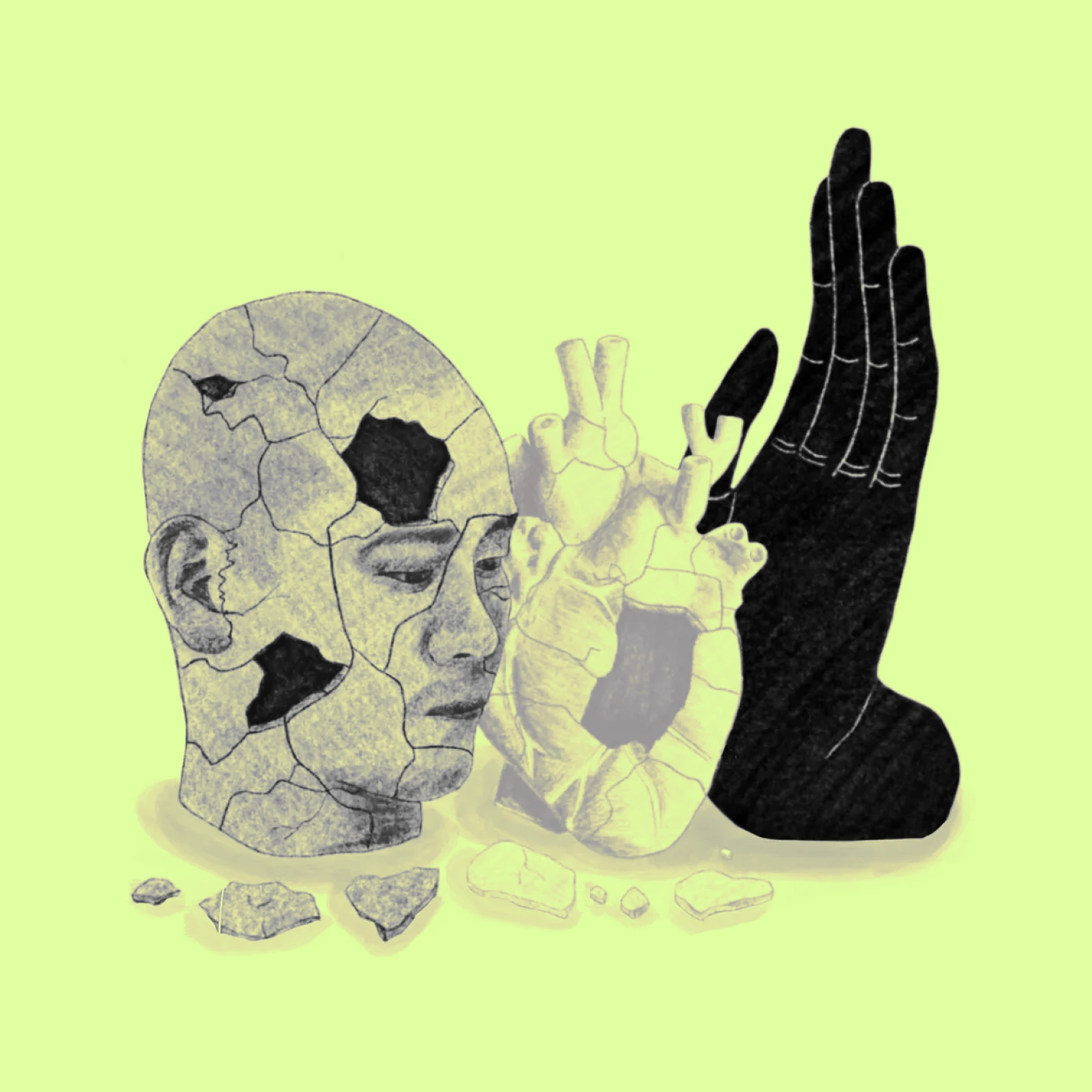
The events of 2020 left many leaders suspended between loss and possibility. In this deeply reflective essay, the author explores heartbreak, transitoriness, and the discipline of holding creative tension. It is a meditation on resilience, leadership, and learning how to stay present in the in-between.
Describing his personal motivation in life as part of a 1950s radio program entitled “This I Believe,” novelist and writer Thomas Mann wrote:
What I believe, what I value most, is transitoriness.In man, transitory life attains its peak of animation, of soul power, so to speak. This does not mean man alone would have a soul. Soul quality pervades all beings. But man’s soul is most awake in his knowledge of the interchangeability of the terms “existence” and “transitoriness.”
To man, time is given like a piece of land, as it were, entrusted to him for faithful tilling; a space in which to strive incessantly, achieve self-realization, move onward and upward. Yes, with the aid of time, man becomes capable of wresting the immortal from the mortal.
For me, 2020 was a year of transitoriness. It sharpened and dulled my sense of time and progress. And with the new year, I admit that I’m not ready to move on just yet. Some might call it needing closure. Others might call it needing a silver lining. I’ll put it down to Thomas Mann—there is “soul power” in 2020 that I am keen to tap into. And as much as I’d like to leave last year in my rearview mirror, I can’t yet say “good riddance,” call it a mulligan, and carry on. It is a year that must be noted. Must be scored. Must be revisited and studied—not to cast aspersions and blame—but to learn.
Sadly, as I write this, my country is reeling from a day when we both certified the election of our 46th president and saw an angry mob of domestic terrorists storm our Capitol Building. We very much continue to be in a state of transitoriness. As individuals and as a collective, we clearly have much reckoning, forgiveness, and healing to do. And so it’s worth pausing to say that what follows is not meant to diminish or be a balm for the wounds from this past year and even more recent events. Rather, this is my initial reflection on these last many months—shaped by my own good fortune and pain, filtered through the lens of my role at SYPartners.
***
Looking back, much of my 2020 was marked by anguish. It featured with a concentration and dogged persistence unlike anything that I’ve experienced before. There was no single act or event that broke me. It was the cumulative effect. Day after day. One thing on top of another. Private and public. Individual and communal. Familial and professional.
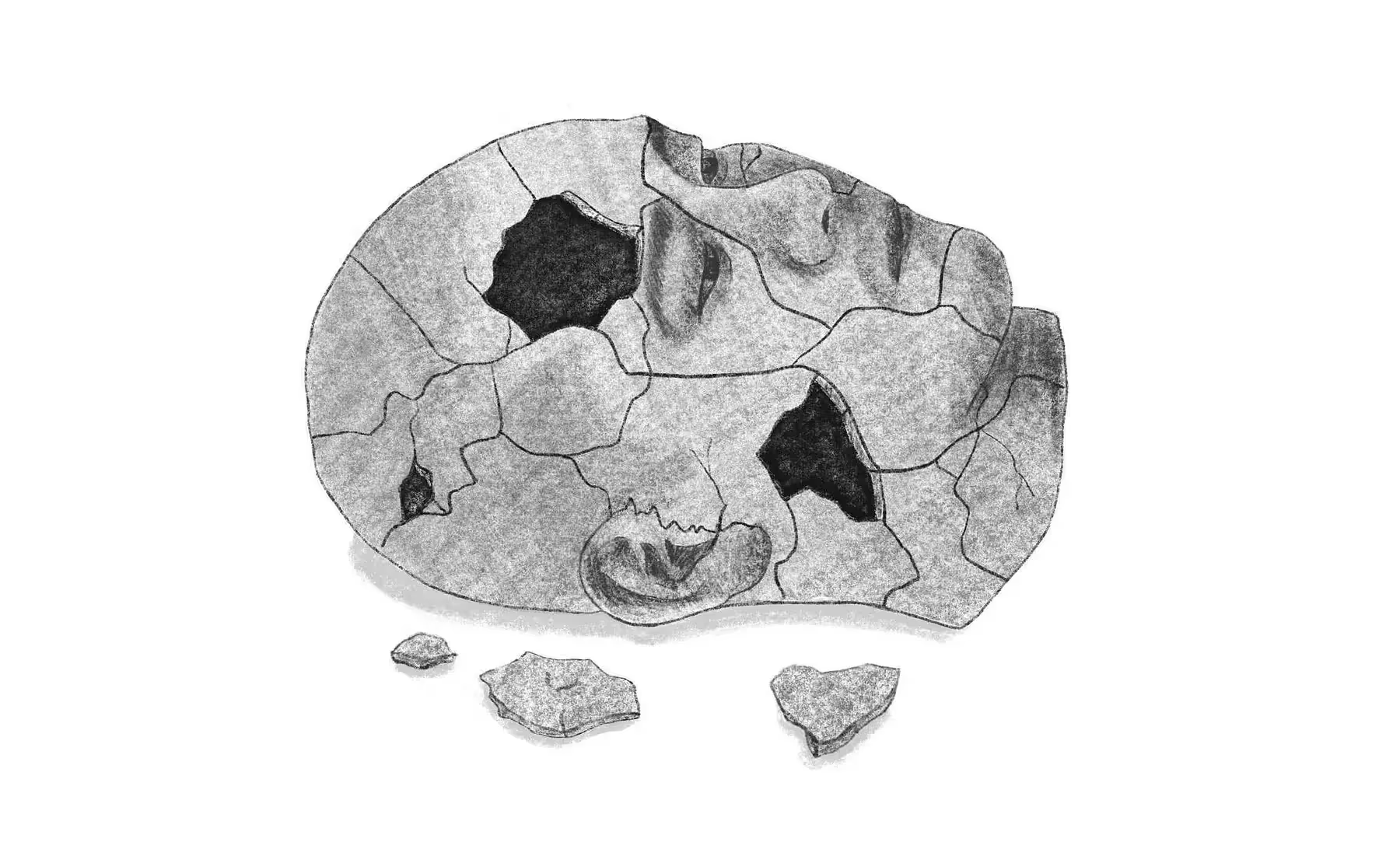
In the first few months, I held a mindset of deposits and withdrawals. I futilely tried to manage and curate what depleted and replenished me. But for each restorative walk, activity with my boys, and joyful experience, there were three, four, five times as many draining Zoom calls, news stories, personal events, practical work-from-home complications—every nuisance seemingly landed with triple the impact. I was empty in short order, fraying and on the verge of cracking into a thousand pieces.
I was experiencing repeated heartbreak, although I didn’t understand that at the time. Parker Palmer, founder and senior partner of the Center for Courage & Renewal and author of Healing the Heart of Democracy, captures perfectly what unfolded next:
Instead of saying “I’m heartbroken” about whatever it is that threatens our version of the American dream—acknowledging our wounds and thus opening them to healing—we withdraw into the silence of private life or express ourselves with the cynicism and anger that make the public realm toxic, producing more psychodrama than social change. … We must understand that these behaviors are the masks heartbreak wears, symptoms rather than the underlying condition.
Right up until the moment I recognized that I was heartbroken, I kept telling myself I must be doing something wrong. I was quick to judge those who I thought were getting it wrong. I grew frustrated easily, believing that someone must have the answer—that there must be something that could be done to make progress, to move forward, to forcibly exit this limbo.
But that’s the thing about heartbreak—it’s a feeling of pain. It’s not about being right or wrong, nor about direction—right, left, forward, backward. As Parker notes, “the sources of our heartbreak are different and often contradictory: what makes my heart sad may make your heart glad.”
So then what? Again, Parker’s insight provided me with a path forward:
If we are able to enter into and consciously engage hard experiences, our heart will get the kind of exercise that can make them supple. But if we try to shield ourselves against life’s teachable moments, our heart—like any unexercised muscle—becomes more vulnerable to stress. Under stress, an unexercised heart will explode in frustration or fury. … But a heart that has been consistently exercised through conscious engagement with suffering is more likely to break open instead of apart. Such a heart has learned how to flex to hold tension in a way that expands its capacity for both suffering and joy.
Exercise. Breaking open instead of apart. Holding tension. The athlete within me stirred. I recalled my own guidance for a strategist’s regimen. I returned to what we hold dear at SYP and in the kyu Collective, of which we are a part—holding creative tensions. I looked inward.
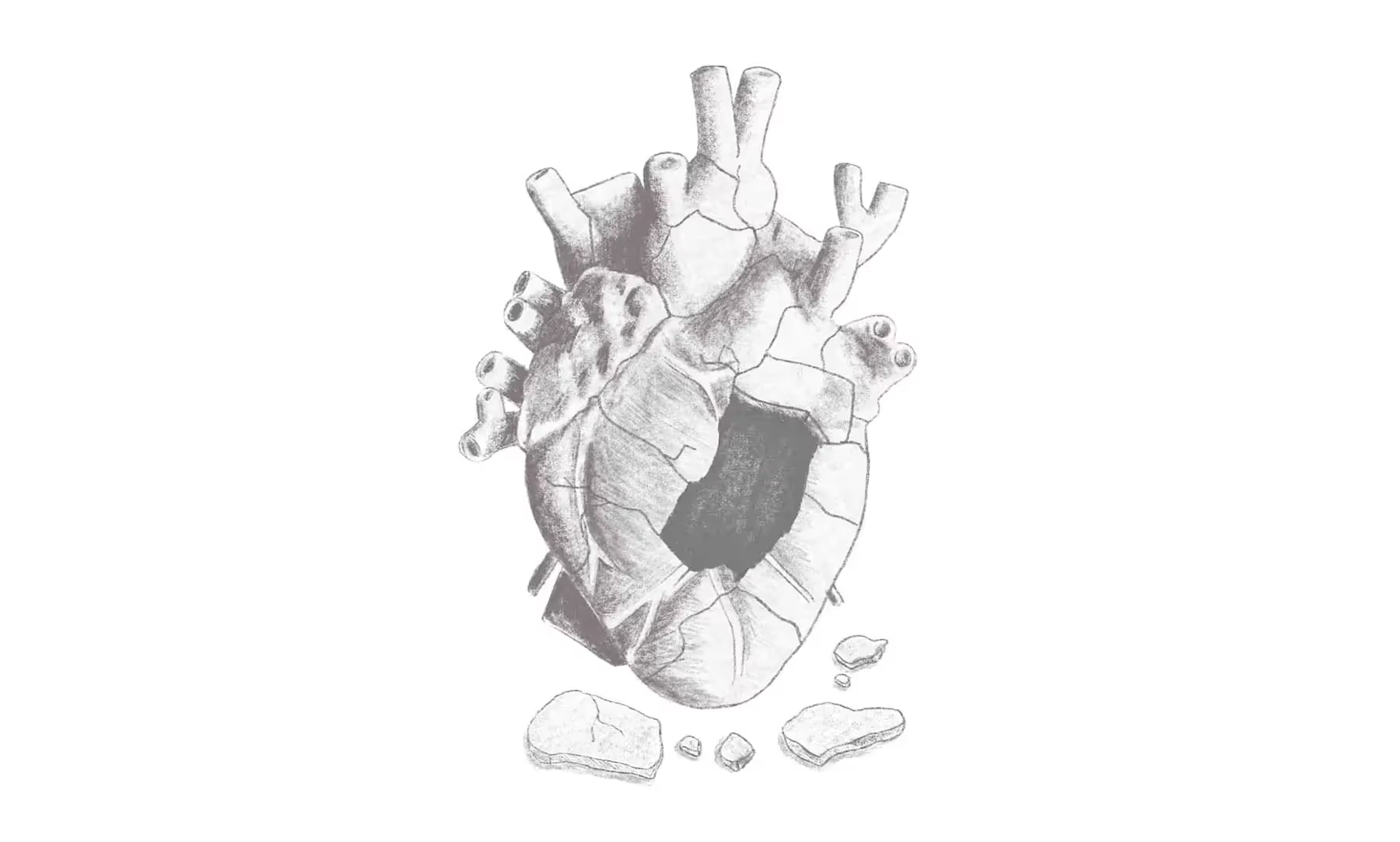
I realized that in my heartbreak, I sought to diffuse tension instead of holding it. I retreated from the in-between to the perceived safety and clarity of a binary mindset. This, not that. That, not this. Only to recognize now, like with a twig, that applying pressure at both ends made me snap in half.
My holiday break gave me a chance to gather the pieces and restore myself. As I enter this new year, I believe there is so much to be hopeful about, even though most of the same challenges remain. And for me, it begins with consciously exercising my heart—this time to be less brittle, more pliable, broken-in to be broken open.
At SYP, we hold a set of six creative tensions near and dear. They inform, guide, and inspire how we think, work, and show up with each other and the clients we partner with. In reflecting on this past year, I find myself returning to three of them in particular.
Empathy & aspiration
An oldie and a goodie. This is one of the first things I learned at SYP, and nearly a decade on, I’m still learning how to practice it consistently. I’ve largely held this in regard to the people I engage with on a daily basis—working to understand where they are and why, while simultaneously holding a sense of possibility for where they could go. This is vital now, perhaps more than ever before.
Yet, at this moment, I find myself needing to practice this with myself more than anything. In lingering too long in empathy, I slipped into a pattern of choosing to suffer on top of genuine suffering. I wallowed. I conflated and created self-inflicted wounds that only furthered my anguish. And in moments when I was stuck at the aspirational end, I kept expecting more of myself, wanting more from myself, until I burned myself out.
I now realize how paralyzed I’ve been ping-ponging between each pole. So I’m endeavoring to return to the space between. To generate a new understanding of myself—of what is real, what is self-imposed, and what I’m capable of doing differently—instead of allowing the seeming contradiction between empathy and aspiration to shut me down. It’s not easy. It’s taken a real commitment to repeatedly look in the mirror, reflect, and confront what I see earnestly. For me, journaling and talking to those who know me best have been most helpful. For others it may be different, but at the end of the day it comes down to oneself. As my dad used to tell me, “Only you can know if you’re telling yourself the truth.”
Declaring & discovering
When it comes to work, I thrive in company—sitting side by side with someone chasing ideas, debating, riffing, sharing contemplative silence. Truly collaborating, I find, naturally instills a sense of curiosity and possibility that makes room for the unexpected. And there’s not much that beats the energy of a group of people jamming together in the same space—it’s a beautiful team sport that has its own rhythm, flow, and potential for improvisation.
With COVID, our primary mediums have become Zoom, Slack, and Google Docs. All great tools, but they’re atomizing. Rather than existing as a unit, we must engage via separate boxes and avatars. We alternate tossing ideas and thoughts over the digital transom, whacking them back and forth with no great way (yet) to hold our ideas together as a group. Increasingly, I talked at people instead of with them, as I spent more and more time in my own head, and less and less time fully present and deeply listening to others. Leading and learning went from a rich, shared experience to a narrow solitary one.
Simply recognizing my unintended shift in behavior has been liberating. I’m now reexamining how I provide guidance, consult, and lead. In doing so, I’ve realized just how poorly words and actions delivered in person translate to digital interactions. Words that would have passed through the air and vanished are now committed to record, reverberating with us for hours and days in our homes. Passing actions in context—small aberrations in facial expression, tone, word choice—now invite interpretation and reinterpretation, dominating headspace.
I’m also seeing how much more proactive I need to be when it comes to learning, expanding, and stoking my curiosity. The serendipity I’ve lost being in person with colleagues and clients has left a gaping hole—one that I’m still working on how to replace and replicate.
Diversity & mutuality
Working from home has given me invaluable, irreplaceable family time. Unequivocally, it’s been the single best thing to happen to me as a result of the pandemic. And yet, the inverse of this wonderful gift has been a conspicuous, if not tacit, absence of “otherness.” Living and working in New York City for the past decade has meant that nearly every day I’ve had the opportunity to step out of my bubble in a variety of ways. Now, contained to my apartment and my family, not only have I struggled to burst my bubble, I can’t help but notice that it’s crystalizing.
To read and hear about the foreign and different is a far cry from experiencing it directly, and I feel poorer for it. It’s harder to empathize. It’s harder to conjure aspirations. It’s harder to have convictions that haven’t been tested by different perspectives and reference points. It’s as if I’m wearing a cast—I am protected, and in that protection, I am also atrophying.
I was already grappling with how to regularly step out of my bubble, and the pandemic amplified the challenge. How does one walk in the company of strangers, much less engage with them, during a politicized pandemic? The value of otherness, strangeness, lies in its ability to teach us and make our lives more expansive. It is the granddaddy of creative tensions. Parker notes, “tension is a sign of life, and the end of tension is a sign of death.” This tension might be the hardest one for me right now. Whereas the existence of tension was my own undoing in the two examples above, here it’s the absence of the tension created by otherness that is the issue.
I’m learning that I must seek out and listen even more deeply to different perspectives and experiences. I must actively reflect on my own patterns of thought and actions. I must face some uncomfortable truths and find the courage to ask hard questions and have uncomfortable conversations. All of which requires slowing down, stepping back, and taking stock of who and what I’m surrounding myself with. It means working to disrupt the monotonous routine that comes with months in transitoriness.
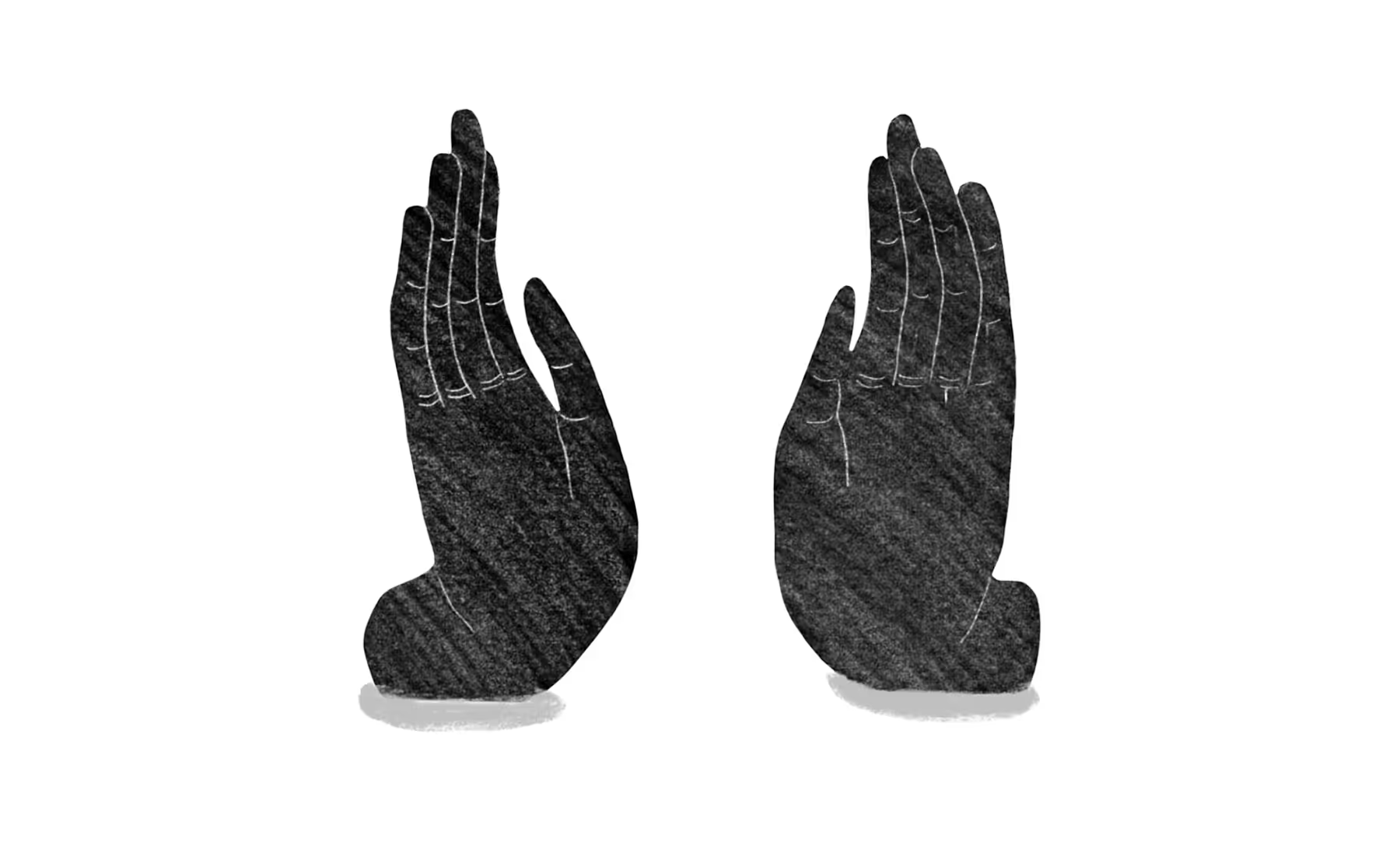
So, no, I’m not ready to move on. I’m learning so much from this past year, and I have so much more to learn still.
Time is a funny thing. It never stops, and yet can stand still. Philosopher Henri Bergson and physicist Albert Einstein memorably clashed on this very topic, contributing in part to Einstein winning the Nobel Prize for the photoelectric effect and not relativity. At the heart of the disagreement: time as a distinct phenomenon versus time as inseparable from us—that time is intertwined with us, in our dreams, memories, and laughter. What a lovely tension. I’m choosing to hold tension creatively. To exercise my heart. To make it supple and flexible. So that the next time it breaks, it breaks open.
More MOMENTUM
Beyond purpose: Unlocking the true potential of cultural organizations
Purpose gives cultural organizations meaning, but it does not guarantee impact. Many struggle to translate noble intent into resilient ways of working. This article explores why organizational design, human systems, and co-creation are essential to embedding purpose and unlocking sustainable cultural transformation.


Values: From corporate fluff to strategic asset
Nearly every organization has a set of stated values, yet few use them as a true strategic asset. Too often, values become generic and interchangeable, guiding behavior in theory but not in practice. This article explores how values can move beyond “corporate fluff” to become distinctive, actionable commitments that shape decisions, culture, and long-term impact.