3 rituals to increase connection in the workplace—no matter how you work


As work becomes more hybrid and distributed, many leaders worry about cultural erosion. Connection, not proximity, is what sustains strong teams and fuels performance. This article explores three practical rituals that help organizations intentionally build relationships, strengthen culture, and support well-being—no matter how or where people work.
You can’t pour from an empty cup. This expression is often used in the context of self-care, but it also applies to teams and work. Our organizations are only as strong as the culture we build within them, and this requires intentional investment in our relationships.
As our idea of office culture transitions to meet a more hybrid future of work, there’s considerable nervousness around cultural erosion—and what this means for the value organizations are able to create. Our culture and connections with one another define our ability to produce great work and push innovation forward. Yet we know organizational cultures fray even when people work side by side, day in and day out. Culture requires strong bonds between people, and proximity doesn’t automatically equate to connection. At a basic level, what we may actually be afraid of is the stretching and breaking of social bonds as our communities become more distributed. This is exacerbated by a renewed cultural focus on the role of work in our lives—do we live to work, finding personal purpose in our careers? Or do we work to live, collecting a paycheck that enables us to fulfill our purpose elsewhere?
Regardless of the answer, when we prioritize a culture that energizes people rather than wears them down, success follows. A University of Oxford study found that happy employees are 13% more productive—not because they work more hours than their discontented colleagues, but because they are simply more efficient with their time. In any organization—whether working together every day in person, hybrid, or remote-first—there is always value in refilling our cups. Here’s how:

1. Top off your cup regularly through small moments of meaningful connection
It’s easy to get stuck in standard everyday pleasantries and mistake working next to one another for working with each other. Making an intentional effort to connect in a meaningful way helps us move out of a transactional work mode and into one with more compassion and humanity. When we take the time to get to know each other, coworkers go from abstractions to real people who really matter to us. Meaningful connection turns into substantive relationships that improve our work and how we accomplish it.
This happens in large part when we make a concerted effort to acknowledge the work everyone is contributing to keep the operation running. Acknowledging others’ contributions is especially essential for those in charge of leading teams. According to Irrational Capital, creator of the Human Capital Index, the No. 1 predictor of stock market success is whether employees feel appreciated; companies for which this is true consistently outperform the S&P 500. Feeling appreciated directly correlates to financial flourishing on all levels—and it doesn’t take much.
Dan Ariely, famed behavioral economist, conducted a study in which people were paid to fill out an arbitrary form and turn it in. When they turned in the form, a researcher would either put the paper directly into the shredder or pause, look over the sheet and then shred it. People for whom the researcher paused were significantly more satisfied with their work.
This example is what psychologists might call a “passive constructive response” of quiet, low-energy support: You tell me something, then I take a moment and say, “Well done.” An “active constructive response”—one of enthusiastic, authentic support that asks for more details—helps build an even stronger relationship.
So much of the research comes back to one central point: Small moments can foster meaningful connection that not only improves the day-to-day experience of people on the ground, but increases a business’s odds for success. These small moments add up, helping maintain the social capital you need to draw on to collaborate and weather tension over time—especially when working together in new ways.

2. Refill the glass to the brim by investing in supercharged moments of connection
Topping off the cup isn’t enough when it’s getting emptied faster than you can replenish it. That’s why it’s also important to refill the glass to the brim every once in a while. This means designing and creating space for specific moments that help people feel connected.
Ask yourself: Even before the pandemic, how often did you bring people together with the express intent of building community? Many leaders lament that they rarely bring their teams together—a sales conference every two years, a special dinner once a year. There’s good reason: It’s expensive, time-consuming and there are competing priorities vying for attention. But these moments of reconnection are worth it, especially if they’re fun.
A study of couples found that those who participated in novel and exciting activities together—anything from zip-lining to learning a short dance routine — reported improved relationship quality. Amazingly, they felt this benefit after activities just seven minutes long. If we extrapolate to teams, we stand to improve team bonds by setting aside time to step out of our collective comfort zone and do something fun—actually fun, not forced fun).
While every workforce will benefit from dedicated time for connection, these investments are especially important for making remote and hybrid work sustainable. Companies that are now primarily remote, such as Shopify and Airbnb, are committed to regularly bringing teams together for in-person connection time, as are companies like Google and Harry’s Inc. that have embraced a hybrid model.
Taking time to bring people together creates a moment of supercharged connection that builds more social capital in an afternoon than you might in months of small talk and meeting updates. As we navigate the evolving future of work, a full-scale return to office cannot be the change we rely on to bring us together. Proximity is not a reliable indicator of connection, and it’s unlikely that the full workforce will ever return to the rigid Monday-Friday work week. Bringing people together should be a celebration, not an obligation.
3. Periodically check your levels by doing a connection audit
Too often, businesses become abstracted to systems and processes — but they are ultimately collections of people, limited by those people’s ability to work together. When employees feel depleted, underappreciated and overlooked, every aspect of the business suffers. When employees flourish, businesses thrive.
Leaders are being called to bring the same level of commitment and attention to employees as they do to customers, yet only 39% of employees surveyed by WTW felt their employer understands them as well as they’re expected to understand customers.
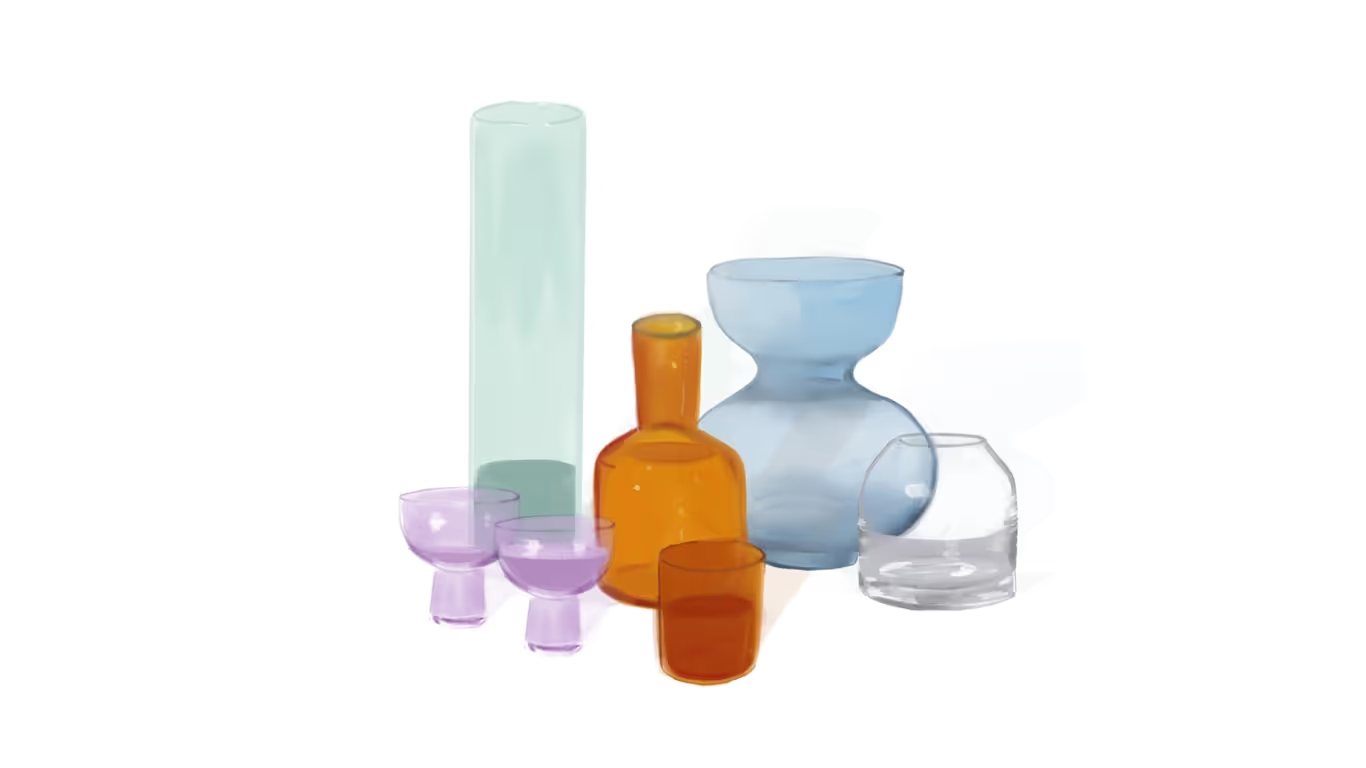
No matter how big an organization gets, at its heart it remains a messy, imperfect, markedly human network. Leaders must stay attuned not only to business performance, but to the humanity that underpins it. Check in on your relationships often and ask: Which glasses are full? How did they get that way? Which glasses need tending? What might be depleting them?
As you ask these questions, check your biases about whose cups you’re filling and how. You may find a tendency to favor people most like you. Yet we know diverse and inclusive teams outperform their peers, generating 30% more revenue per employee and greater profitability. Creating that value requires meeting each team member where they are and filling their cup in the ways they need, not the ways you prefer.
If we never make a point to connect with one another, our cups will empty. That isn’t a product of hybrid or remote work—it’s the result of neglecting relationships. With increasingly global, matrixed and distributed workforces, companies must now fuel connection by design.
More MOMENTUM
Navigating the shift from founder-led to founder-inspired
Leadership succession is an opportunity to strengthen—not replace—a founder's legacy. By distributing decision-making, codifying culture, and creating shared ownership, organizations can preserve what made them successful while building resilience for the future.

Zero-gravity leadership in the Age of AI
Leadership is being reshaped as AI rewrites how organizations operate. Informed by executive conversations and SYPartners’ research and client work, this perspective outlines the capabilities leaders need now, with a full report available to explore further.

Collective leadership: The operating model for modern executive teams
Collective leadership is reshaping how high-performing organizations operate. As complexity grows, leadership must move beyond hierarchy to enable faster decisions, stronger alignment, and shared accountability across teams. Organizations that distribute leadership behaviors across functions are better equipped to perform at enterprise scale.